

Moonstone
The name Moonstone is derived from its shimmery appearance, called adularescence. Adularescence is a visual effect where a soft white or blueish white light appears to move beneath the surface of the gemstone. This effect is caused by light passing through ultra-thin microscopic layers of different feldspar minerals. The light is scattered and so produces a beautiful soft glow. The Roman scholar Pliny the Elder coined the term “Moonstone” and noted that the stone`s shimmer changed with the phases of the moon.
Moonstone is part of the feldspar group of minerals, other well-known gemstones in this group include Amazonite and Orthoclase. Moonstone can be a number of different colours including colourless/white, grey, apricot, pink, green, and yellow to brown. With the most valuable colour being transparent and colourless, containing a strong blue adularescence. Which produces a vivid blue glow that appears to hover above the gemstone surface.
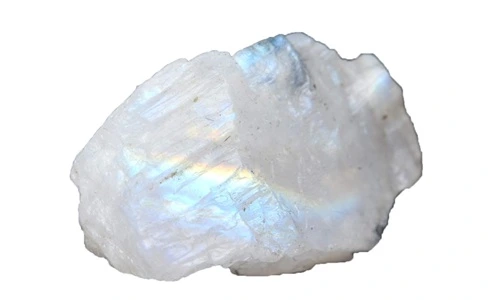 Formation: Moonstone is composed of potassium aluminium silicate. The stone contains intermingled layers of feldspar minerals, Orthoclase and Albite. The process starts deep within the earth`s crust, when magma cools within igneous rock such as pegmatite or granite. Both feldspar minerals, Orthoclase and Albite crystallise together in tightly interwoven layers. As the magma continues to cool down very slowly both minerals separate into microscopic alternating layers, in a process called exsolution. This alternating laying of the two different minerals is what produces the optical effect called adularescence.
The most important deposits are found in Sri Lanka. Other deposits are located in India, Myanmar, Madagascar, Brazil and the United States.
Treatment: Natural, untreated Moonstone particularly colourless, transparent stones with a strong blue adularescence are considered the most valuable. As a general rule Moonstone is typically not treated. However, there are a number of treatments which can be applied to lower-quality stones.
Surface-coating: A very thin coating of vaporised metal oxides can be applied to the back of a cabochon gemstone to enhance the adularescence and or improve the colour of the stone. This process works much in the same way as foil-backed gemstones, which was commonly used in Georgian Jewellery. These thin coatings of vaporised metal oxides are not permanent and tend to be worn away from normal wear.
Heat Treatment: Stones of a lower quality are occasionally heat-treated to improve their clarity and to intensify their colour. However, this heat treatment can make the gemstone more brittle and susceptible to being damaged.
Dyeing: Although rarely done, lower-quality stones can be dyed. It should be noted that these dyes are generally not stable and as such tend to fade over time.
Fillers: For lower-quality stones with fissures or cracks, these can be filled with a polymer. Which will improve its structural strength and its clarity.
Durability: Moonstone has a hardness rating of 6 to 6.5 on the Mohs scale, which makes it suitable for occasional wear rather than everyday wear. This is particularly the case for rings and bracelets which are more prone to impacts. Other more protected jewellery such as earrings and necklaces could be worn more frequently.
Moonstone is sunlight stable and will not be effected by natural light. If the stone however has been dyed, then care such be taken to avoid prolonged exposure to sunlight.
Moonstone is sensitive to heat. High temperatures and or rapid changes in temperature can cause it to crack from thermal shock. High temperatures can also cause a loss of adularescence.
For storage, it is recommended to keep this gemstone in a soft cloth pouch or keep it separate from other jewellery as it can be easily scratched.
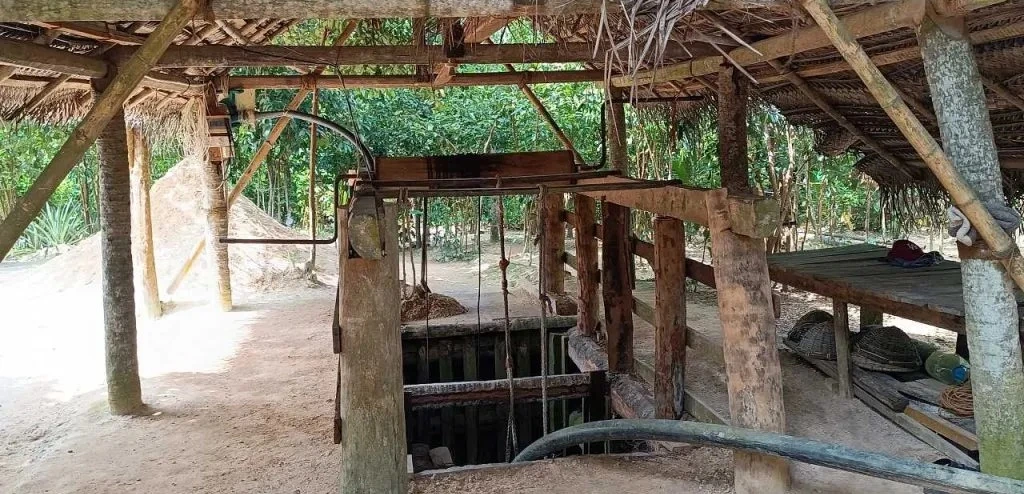
Moonstone Mine located in Sri Lanka
Meaning and Healing Properties
Moonstone with its captivating shimmering silvery glow, has strongly been associated with the moon and the lunar cycles. It symbolises feminine energy, new beginnings, intuition and emotional balance. The stone is said to be a protective stone for travelers, particularly those who are undertaking journeys at night time. It is also a protective stone for both mothers and children. Since this gemstone is a”lighted” gem (adularescence), it is said to bring good luck and love to the wearer. The stone was even credited with helping to reunite estranged lovers.
Throughout time, the stone has been associated with a number of healing properties. The stone was said to balance the wearer`s emotions by stabilising their moods and reducing anxiety. It is also said to balance hormones, aid digestion and improve sleep.
Chakra: Moonstone`s primary association is with the third eye chakra, which helps to promote intuition. It is also associated with the crown chakra, which helps to promote wisdom and enlightenment.
Birthstone: Moostone is the birthstone for June, along with Alexandrite and Pearl.
Zodiac Astrology: Moonstone is most strongly associated with the star sign Cancer, as the moon is its ruling planet. It is also associated with Gemini since it is June`s birthstone.
Wedding Anniversary: Moonstone is an alternative gemstone for the 3rd wedding anniversary. The traditional 3rd wedding anniversary gemstone is Pearl.
History
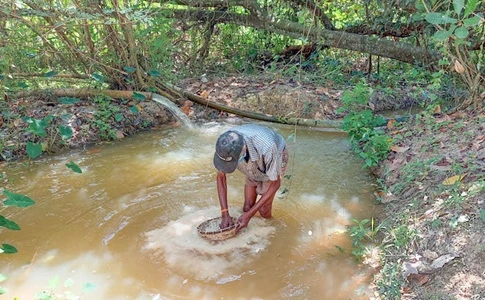 The earliest known mining of Moonstone was in Sri Lanka, dating back around 2,500 years ago. Mining was traditionally small-scale localised operations and under the control of the Sinhalese monarchy. The stone was highly prized and of significant cultural value in Sri Lanka.
In the 18th Century, commercial mining operations began in the Ambalanngoda region. This region is famous for its Moonstone-rich pegmatite deposits, which yield the rare blue Moonstone. In 1906, the world-famous Meetiyagoda deposit was discovered. The Meetiyagoda deposit produces the highly sought after blue-sheen Moonstone and along with other active mines in the region is the world`s primary source.
Historically Maynmar ( Burma ) was an important source of Moonstone, with mining taking place in the Mogok Stone Track. Moonstone is mined here along with other gemstones such as Rubies, Sapphires, Spinel and Peridot. The earliest documented evidence of mining here is from 1597 AD. When the King of Burma took control of the Mogok mines from the local Shan rulers. But it is believed that mining in the Mogok Stone Track is much older. There is a local legend that claims hunters in the 12th Century found Rubies laying on the ground in what became known as the “Valley of Rubies”. One particular area in the Mogok Valley called Shwe-Pyi-Aye was famous for its high quality Moonstone. Today deposits of high-quality blue Moonstone in the Mogok Stone Track are largely considered depleted. Current mining of the stone in the region is as a byproduct of Ruby and Sapphire mining. With activity being carried out by small-scale artisanal pit mining or the reworking of old mine tailings.
India was another historically important source of Moonstone, particularly for coloured Moonstone which mostly comes in green, peach and grey. India also produces “Rainbow Moonstone” which is a variety of Labradorite. Mining in India is believed to date as far back as 3,000 BC, with documented evidence mentioning Moonstone in the 3rd Century BC. Historically, Bihar and Rajasthan where the most important mining areas in India. From here the gemstone was traded along the Silk Road, both to Europe and other parts of Asia. Demand for the stone reached its height during the Art Nouveau period. When jewellers and designers such as Rene Lalique turned away from using expensive precious gemstones to using more semi-precious gemstones. With the emphasises on the artistic value of the piece rather than the intrinsic value.
Currently, deposits are mined in Sri Lanka, Myanmar (Burma), India, Brazil, Madagascar and the United States.
Folklore
Throughout time, Moonstone has been strongly associated with the moon and the lunar cycles. In ancient cultures, the stone was believed to contain moonlight which was solidified within the stone. The connection between the stone and the lunar cycles made it a powerful symbol of fertility and it was used by women for centuries as an aid to conception. Women would sew the gemstone into their clothes to increase their chances of conceiving and as a protective talisman, particularly during childbirth. Since the moon goes through cycles and renews itself every month, Moonstone was often referred to as the “Stone of New Beginnings”. The stone was believed to reconcile couples after an argument and even to reunite estranged lovers. Legend has it that if a person was to place the stone in their mouth, they would have a vision of their future, particularly about their romantic future.
The stone was also used as a powerful talisman for travelers. It was believed to protect sailors at sea, due to the moon`s influence on the tides. It was also used by those journeying by land, in the belief that it would protect them especially if they were traveling at night.
In ancient Egypt, the stone was associated with the goddess Isis. It was a symbol of fertility, protection and rebirth. There has been archaeological finds of the stone buried with women. The ancient Egyptians believed that the “inner light” of the stone would guide them through the darkness of the underworld to eternal life. They also believed that Moonstone held prophetic powers and it would grant the wearer visions in their dreams.
Greek Mythology: The ancient Greeks called the stone “Aphroselene” which was derived from Aphrodite, the goddess of beauty and love, and from Selene goddess of the moon. To them the stone represented the lunar cycles and romantic love. Legend has it that Moonstones were the tears of Selene. Which is similar to other widespread beliefs that the stone contained moonlight. The Greeks associated the gemstone with the “divine feminine” and fertility. It was said to increase a woman`s fertility and if placed near crops while they were growing, it would ensure a bountiful harvest. The Greeks also believed the stone had the power to bring forth visions of the future if placed in the mouth during a full moon.
Roman Mythology: The ancient Romans associated the stone with Diana, goddess of the moon and the hunt. They believed that the stone was drops of moonlight which fell to earth. Pliny the Elder studied the gemstone and he noted that the stone`s shimmer would increase and decrease with the lunar cycle. Moonstone was widely used in ancient Rome both for jewellery and as a talisman. They believed it could aid fertility and protect women during childbirth. They also believed the stone could provide clarity of thought to the wearer and so improve decision-making.
Medieval Europe: In medieval Europe, Moonstone was considered a very powerful “Dream Stone” which could connect the subconscious with the lunar cycles. Alchemists would use the gemstone for scrying. Scrying is an ancient form of divination, whereby the Alchemist would stare at the gemstone in an attempt to open a portal and allow visions of the future. Much in the same way that a fortune teller uses a crystal ball.
The stone was also considered a protective stone, particularly for travelers at night. This was a widespread and persistent belief from a much earlier time. During this period, Moonstone was used as an aphrodisiac and was said to create eternal love between couples. The stone was also said to have the ability to mirror the wearer, if the wearer was angry or was holding a grudge then the gemstone would lose its shimmer and become dull.
Famous Moonstone Jewellery
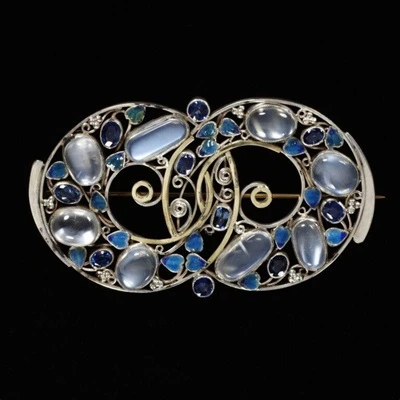
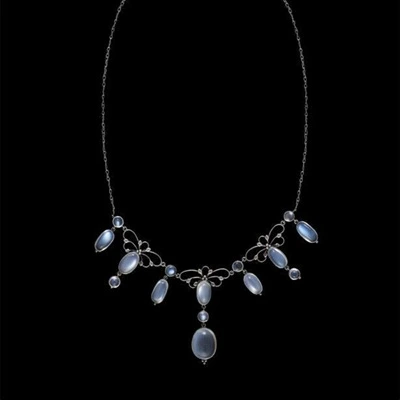
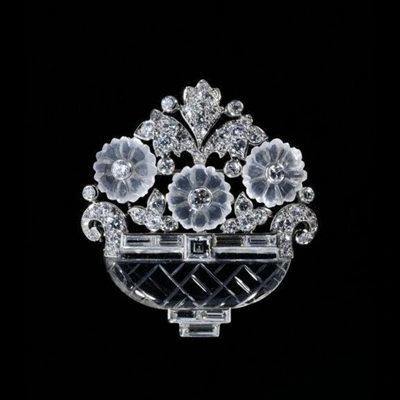
The above pieces of Moonstone jewellery are on display at the V&A Museum.
Moonstone Gemological Data
Colour: Colourless, yellow, pale sheen.
Colour of Streak: White.
Moh`s hardness: 6 – 6.5
Density: 2.56 – 2.59
Cleavage: Perfect.
Fracture: Uneven, conchoidal.
Crystal system: Monoclinic; prismatic.
Transparency: Transparent to opaque.
Chemical composition: K[AISi3O8] potassium aluminium silicate.
Refractive index: 1.518 – 1.526
Double refraction: -0.008
Pleochroism: Absent.
Dispersion: None.
Fluorescence: Weak; bluish, orange.
For Researchers and Journalists
Recommended Citation (MLA) Format:
Hoyne, John. “Moonstone: Formation, History, Meaning, and Folklore.” Carus Jewellery, n.d., https://carusjewellery.com/moonstone/.
You can also get in touch with Carusjewellery.com on Facebook , where you may leave any comments or questions you may have about this article.
