
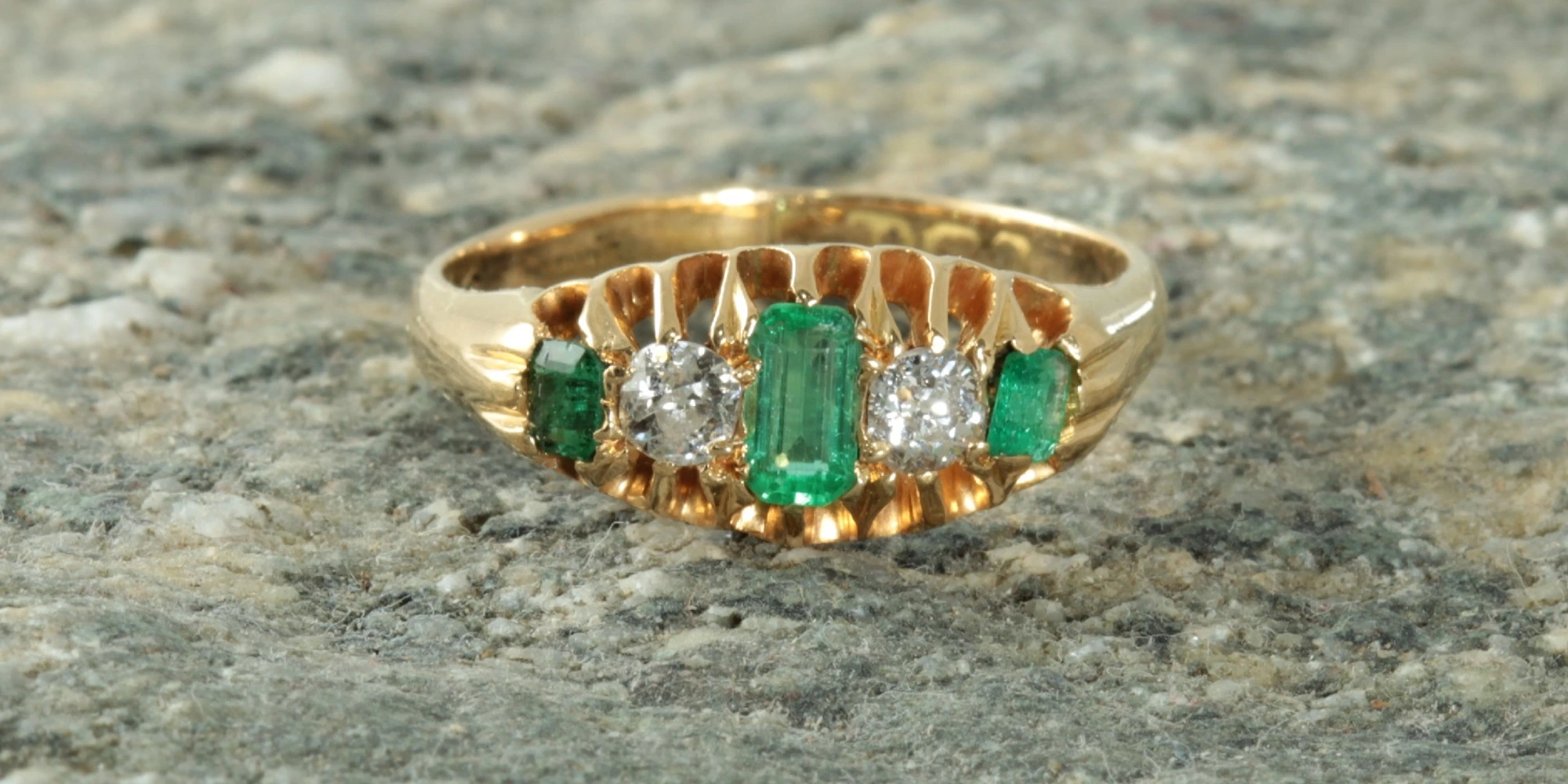
Emerald
The name Emerald is derived from the ancient Greek word smaragdos which translates to “green gem” or “green stone”. This word smaragdos itself is likely to have derived from the Persian word zamarat meaning “heart of stone” or it could have derived from the Sanskrit word marakata meaning “the green of growing things”. The Greek word smaragdos was then taken by the Romans, where it evolved into the Latin word smaragdus and over time, the Romans altered it into esmaralda or esmaraldus. These Latin words in turn became esmeraude in old French, which evolved into emeraude. Finally evolving into the English word Emerald during the 14th century. It should be noted that all of these original terms, such as smaragdos were in fact used to describe all green gemstones such as Peridot, Tourmaline, and Malachite etc.
Emerald is composed of aluminium beryllium silicate (Al2Be3[Si6O18]) and it belongs to the Beryl mineral group. Within the Beryl group, green beryls are called Emerald, blue beryls are called Aquamarine and all other colours are called Precious Beryl. Light or pale green beryl is not classed as Emerald but rather sold as green beryl. Emerald is the most valuable gemstone within the beryl group.
Geographic Varieties of Emerald
- Colombian Emeralds: This variety is considered the finest in the world. It gets its colour from chromium and is a pure, vivid grassy green colour, with a soft glow.
- Zambian Emeralds: This variety tends to be a darker green colour, with a bluish-green undertone due to its high iron content. These stones have excellent clarity with few inclusions.
- Brazilian Emeralds: This variety tends to be lighter in colour, with a yellowish-green or mint green tint. These stones have excellent clarity with few inclusions.
- Russian Emeralds: This variety is a bright green with yellowish-green to bluish-green tones. Currently mined in the Sverdlovsk region of the Ural Mountains.
- Afghan Emeralds: This variety is an exceptionally bright, pure green colour, with excellent clarity. They are mined in the Panjshir Valley in Afghanistan. These stones are on a par with Colombian Emeralds.
- Pakistani Emeralds: This variety is an intense, deep green colour but they tend to be small in size. They are mined in the North West of Pakistan.
- Zimbabwean Emeralds: This variety is a vivid, deep green colour, a result of its high chromium content. Like those from Pakistan, they tend to be small in size.
- Ethiopian Emeralds: This variety has exceptional clarity and a beautiful green colour, with bluish-green tones. They were only discovered in 2016, which makes them relatively new to the market.
Rare Varieties of Emerald
- Trapiche Emeralds: This variety features dark spoke-like segments which radiate out from the centre, which looks like a star or a cartwheel. This phenomenon is caused by carbon impurities. This rare variety is generally only found in Colombia.
- Cat’s Eye Emeralds: This is an extremely rare variety, where parallel needle-like inclusions form a line across the gemstone. This line is reflective and when the stone is cut as a cabochon, it will resemble a cat’s eye.
Formation
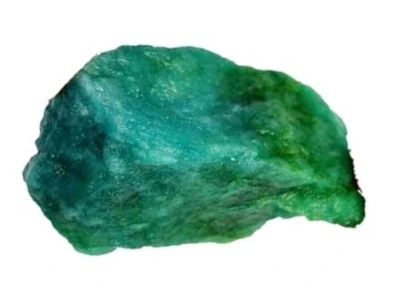 The formation of Emerald requires two incompatible elements, beryllium and chromium to mix together. Not only are these two elements incompatible but they normally exist in completely different host rocks. It is for these reasons that Emerald is so rare and more expensive than Diamonds. There are two geological processes by which this gemstone can form: Hydrothermal deposit and Magmatic-Metamorphic deposit.
- Hydrothermal Deposit: This process begins with tectonic activity, which creates massive fissures in the sedimentary rock. Searing hot mineral-rich water is then forced up through these fissures, carrying with it dissolved beryllium. This beryllium then mixes with the chromium within the sedimentary rock. As the hot fluids cool down, beryllium and chromium crystallise together to form Emerald.
- Magmatic-Metamorphic Deposit: This process begins when molten magma that is rich in beryllium pushes up into pre-existing metamorphic rock that is rich in chromium or iron. Where the magma and the metamorphic rock meet, there is immense heat and pressure generated. Under this heat and pressure, the elements mix and then crystallise into Emerald.
Since both processes involve extreme heat and pressure in a violent process, tiny microscopic gas bubbles or liquid bubbles tend to get trapped within the growing crystals. Other trace amounts of minerals can also get trapped during this process. As a result, nearly all Emeralds have inclusions to a varying degree. These clouds of inclusions are referred to as jardin (French for garden) because they resemble moss or a garden. Jardin is not classed as a fault, rather it is used as evidence of the genuineness of the stone compared to synthetic stones.
Treatments
The vast majority of Emerald on the market has been treated in one form or another. It is estimated that about 95% of Emerald has been treated to enhance its clarity. So the chances of finding a completely natural Emerald is extremely rare. As such reputable labs such as the Gemological Institute of America (GIA) actually grade Emeralds on the level of clarity enhancement. During their assessment they look at the amount of oil or resin which has penetrated the stone. They grade from minor enhancement, which is a tiny amount of oil in the stone. To moderate enhancement, which is normal for retail jewellery. To significant enhancement, which means the stone was heavily included and contains a large amount of oil. These ratings have a significant impact on the stone’s market value.
- Oil Filling: This is the most common treatment and is considered an industry standard practice. The process involves the stone’s surface-reaching inclusions being filled with oil, typically cedarwood oil as its refractive index matches that of Emerald. This is done under vacuum pressure in order to draw the oil into the stone as deeply as possible. This treatment will improve the stone’s clarity but is considered temporary and may need to be reapplied.
- Resin Filling: This is a similar process to oil filling but instead of using oil, a synthetic resin such as opticon is used. Unlike oil, this resin will harden and be more durable. This treatment is considered permanent to semi-permanent. It should be noted that this treatment can discolour if exposed to prolonged sunlight.
- Dyeing: This treatment involves adding a green dye to the oil or resin and treating as outlined above. This treatment is viewed as deceptive within the gem trade because these dyes are typically unstable and will fade quickly when exposed to sunlight and or mild soapy water. Dying is normally done on low-grade stones to temporarily make them appear as high-quality.
- Backing: This treatment involves placing a green backing of plastic, lacquer, enamel or a reflective foil directly onto the back of the gemstone. This treatment like dyeing, is a deceptive and temporary treatment. As the backing can easily be removed by scratching it off or by being dissolved in soapy water.
- Lead-Glass Filling: This treatment involves the filling of heavily included stones with green lead-glass. Lead-glass has a similar refractive index to Emerald and as such becomes invisible to the naked eye. This treatment will stabilise heavily included stones and improve their clarity. However, a jeweller’s torch, household cleaning agents and or an ultrasonic cleaner can easily destroy glass-filled Emeralds.
Durability
Emerald has a hardness rating of 7.5 to 8 on the Mohs scale, making it a relatively hard gemstone with excellent resistance to scratches. However, Emerald by its nature is brittle, which is caused by the jardin. Jardin is clouds of inclusions within the gemstone’s structure, which cause internal weakness in the structure. A hard impact or thermal shock can easily chip or shatter this gemstone.
To help counteract this weakness within the crystal’s structure, gem cutters invented the Emerald cut. This cut is a rectangular shape, with bevelled edges and corners, which helps to eliminate the most vulnerable edges from being chipped.
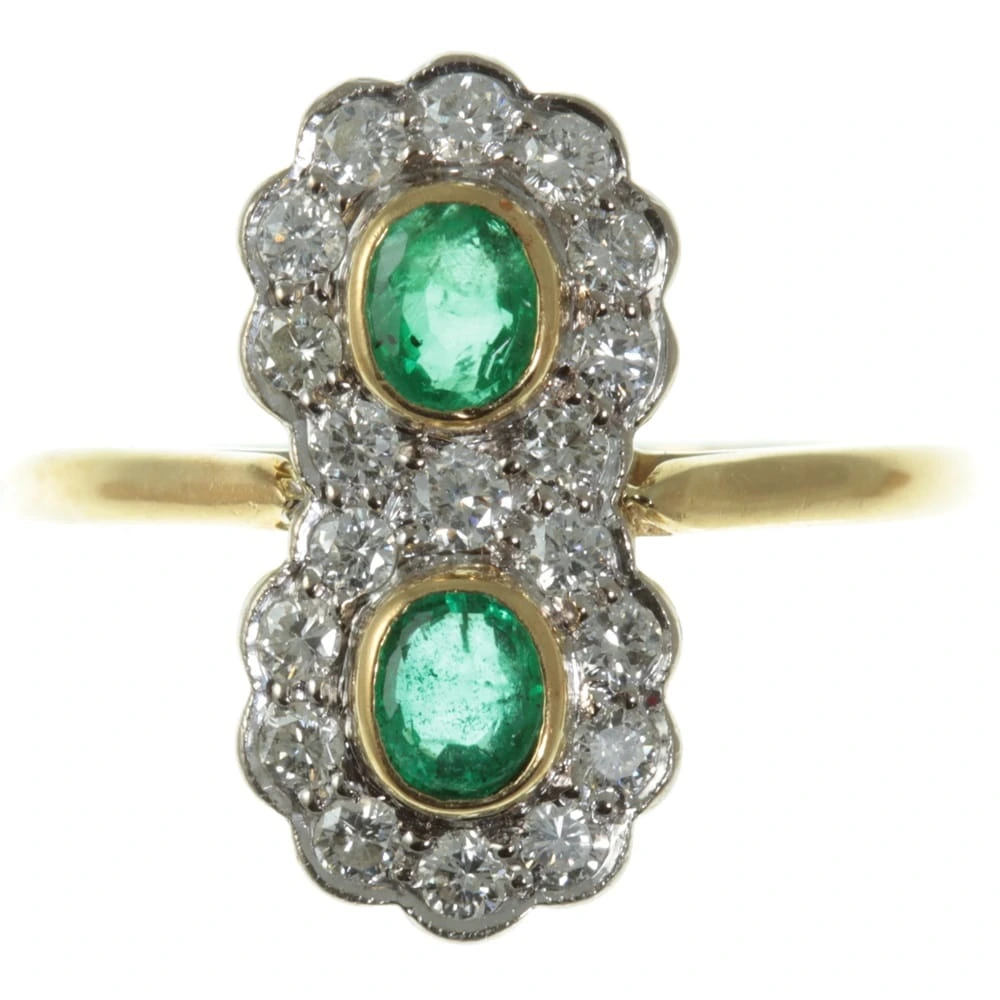
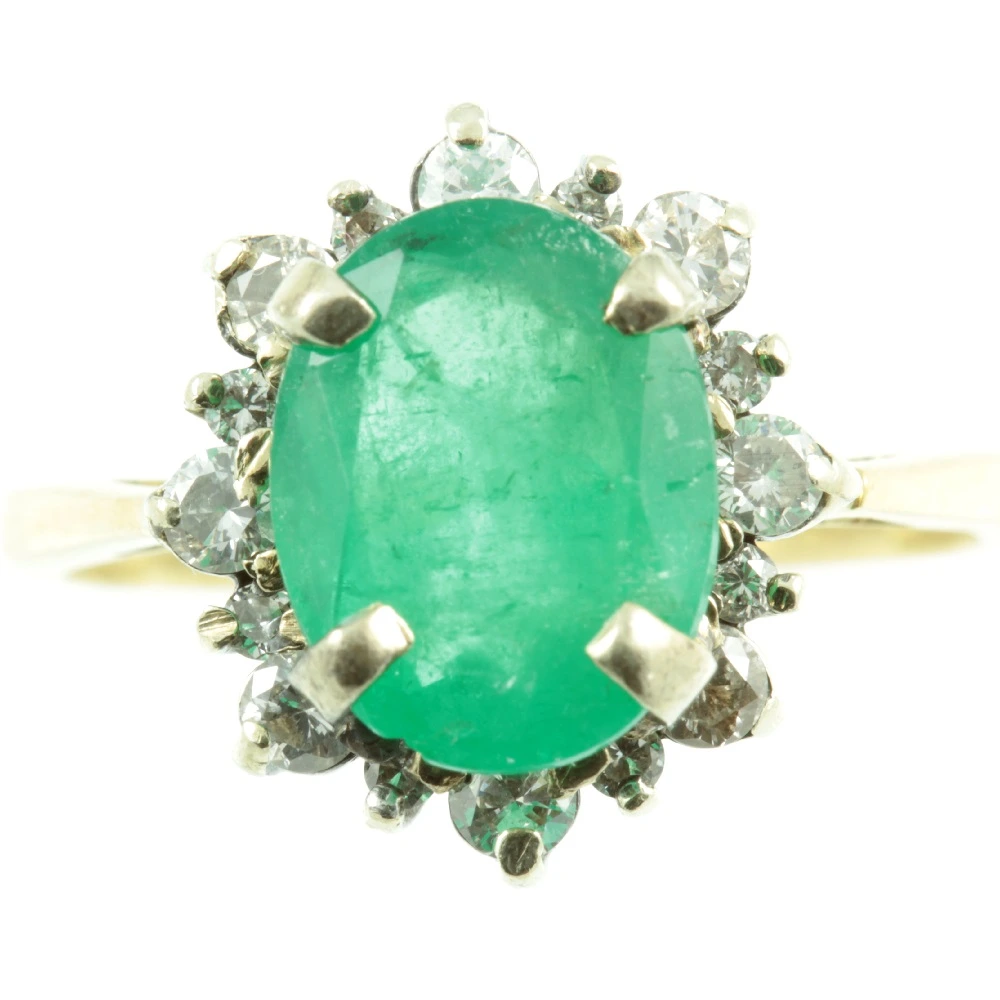
Over the years here at Carus Jewellery, we would generally recommend a rub-over setting (bezel) for Emeralds, particularly for rings that are to be worn regularly. This type of setting offers the best protection, an example of which can be seen in this Double Cluster Emerald and Diamond Ring. Emeralds are suitable for everyday wear providing care is taken and by utilising a rub-over setting, you give yourself that extra bit of security.
- Sunlight: Emerald is sunlight stable and will not fade in colour even if exposed to prolonged and intense sunlight. It should be noted that while the stone itself is sunlight stable, prolonged exposure to sunlight can cause the oil in treated stones to degrade and dry out or turn yellow.
- Heat: This gemstone is extremely sensitive to heat and thermal shock. Sudden and rapid changes in temperature can cause it to crack. Given that about 95% of all Emerald is oil-treated, even moderate heat can cause this oil to leak out or sweat out of the stone, resulting in the stone’s jardin becoming more visible.
- Chemicals: Emerald is highly sensitive to most household chemicals. The majority of which will act as a degreaser and as such will remove the cedarwood oil or dissolve any resin the stone may have been treated with. Perfumes, hairspray and lotions can also adversely affect this gemstone. So it is recommended to apply your makeup and perfume first and allow them time to dry. Then put on your Emerald jewellery, this will minimise any contact.
- Cleaning: The safest way to clean your Emerald jewellery is with lukewarm water and a mild, detergent-free soap such as baby shampoo. Then clean using a soft toothbrush gently in order to avoid catching the bristles of the toothbrush in your jewellery settings, which may dislodge the gemstones. When finished, rinse your jewellery thoroughly under lukewarm running water. Ensure the plug is placed in the sink while you rinse, to prevent small items from being accidentally flushed down the drain. Ultrasonic or steam cleaners should never be used for Emeralds, as this gemstone is sensitive to thermal shock and can easily shatter.
- Storage: While this gemstone has excellent resistance to scratches, it can scratch softer gemstones such as Opal or Pearl. For this reason, it is always recommended to store it in a separate compartment within your jewellery box or to place it in a soft cloth pouch. This stone should also be stored in a cool, dry place away from any source of heat or humidity and out of direct sunlight.
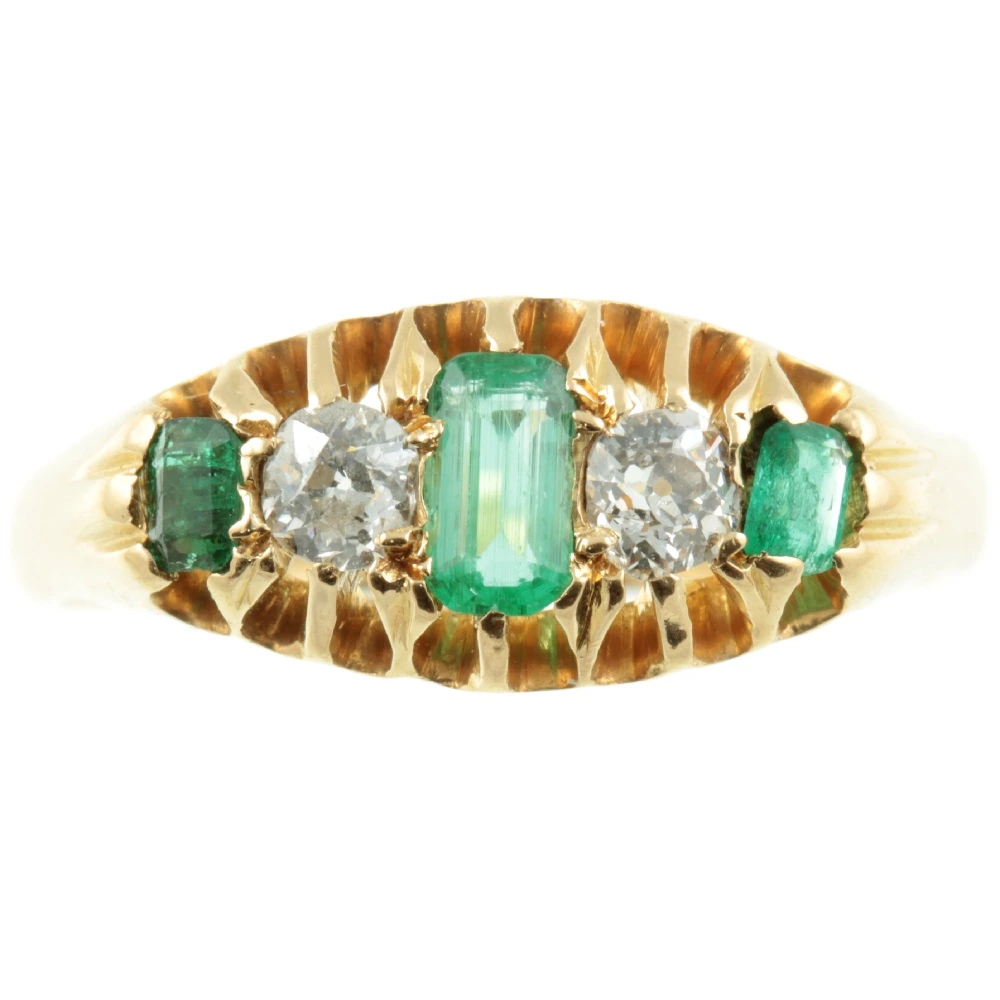
Meaning and Healing Properties
Historically, across different cultures, Emerald’s vivid green colour has symbolised rebirth, fertility and love. Its beautiful green colour has always been associated with nature’s new green growth of spring and vitality. The stone was traditionally called the “Stone of Successful Love”. In mythology, Emerald was associated with both Venus and Aphrodite, the goddesses of love, beauty and fertility. Ancient people believed that wearing an Emerald would ensure eternal love, romance and domestic bliss. Ancient people also believed that this stone was prophetic and that by placing it under your tongue, you would be able to see the future. Doing this was also said to grant the person the ability to speak with profound eloquence. This gemstone was also credited with a number of physical healing properties. It was said that if a person gazed into an Emerald it would soothe score eyes and restore failing vision. It was also used as an antidote to poison and was said to have the ability to detoxify the liver and kidneys.
Chakra: Emerald is associated with the heart chakra, which helps to promote love, compassion and emotional healing.
Birthstone: Emerald is the official birthstone for May. Agate and Chrysoprase are alternative birthstones for May.
Zodiac Astrology: Emerald is associated with the star signs Taurus and Gemini.
Wedding Anniversary: Emerald is the 55th wedding anniversary gift, symbolising enduring love, wisdom and resilience.
History
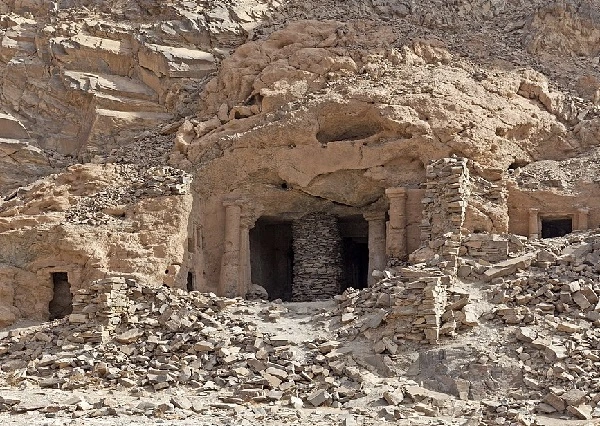 Emerald has an incredibly long history, dating back over 4,000 years. The earliest known mining of Emerald took place in Egypt’s Eastern Desert near the Red Sea. Mining took place on Mount Smaragdus (Emerald Mountain), which would later become known as “Cleopatra’s Mines”. These mines were the world’s primary source of Emerald up until the early 16th century. The colour green was sacred to the ancient Egyptians, it represented the fertile green fields after the Nile’s annual flood and as such eternal rebirth. The stone was frequently buried with the pharaohs to ensure their safe passage in the afterlife. Cleopatra had a particular fondness for the stone. She used it in both jewellery and to decorate her palaces lavishly. She would also give visiting dignitaries gifts of the stone containing intaglios of her own image. After the Romans took control of Egypt in 30 BC, they intensified mining operations under military control. Mining during this time was a brutal affair, with slaves and labourers digging tunnels into the rock, some as far as a hundred metres. The Emerald from these mines was heavily included and would be considered low-grade by our standards today but at the time they were pretty much the only source. By the Middle-Ages the mines were becoming exhausted and were completely abandoned by the early 1500s when deposits of Emerald were found in Colombia. After which Cleopatra’s mines were lost to time and only rediscovered by Frederic Cailliaud, a French naturalist and mineralogist, in 1816.
The only ancient European source of Emerald was in the Habachtal mines located in the Alps of Austria. The Celtics collected Emerald here from the Valley’s secondary (alluvial) deposits, while they were sourcing copper ore. Emperor Nero is said to have viewed gladiatorial games through a flat-cut Emerald sourced from the Habachtal mines. The Romans did sporadically work these mines at Habachtal but their high altitude made large-scale mining very difficult. Mining activity stayed sporadic throughout the Middle-Ages. In 1862, Samuel Goldschmidt purchased the mining rights there and made a concerted effort to commercially mine it. He did manage to dig four separate tunnels and successfully brought Austrian Emeralds to the London World Industrial Exhibition in 1861. However, following his death in 1871 operations ceased. Since then mining has been intermittent and to the present day mining is only occasionally done.
In the early 16th century, when the Spanish Conquistadors invaded South America, they saw the native Incas and Aztecs wearing Emeralds. They then tracked down the source of these gemstones, which was from the Muzo mines. It was Don Gonzalo Jimenez de Quesada who discovered the mines in 1538, but the Spanish faced fierce resistance from the native Muzo tribe. It took almost twenty years of brutal conflict before the Spanish took control of the mines. Once they had control, they enslaved the local people and started extraction on an industrial scale. The Emeralds from Colombia were of exceptional quality and clarity, far superior to the Egyptian Emeralds. Once mining operations were established, the Spanish started exporting vast amounts of Emerald to Europe and Asia. The influx of Colombian Emeralds into Europe, transformed Georgian Jewellery. The old Austrian and Egyptian Emeralds were heavily included and required foil-backed closed settings to brighten them. These new imported stones were exceptionally bright and vivid, which allowed for the use of open back settings. These Emeralds were also widely used in acrostic jewellery to represent the letter “E”. During the Victorian Era, Emeralds saw a rise in popularity, driven by Prince Albert. Who in 1845, commissioned a stunning Emerald and Diamond tiara for Queen Victoria, featuring nineteen large pear-shaped Emeralds. The Emerald cut was further refined during the Victorian Period. More symmetrical tiers were added to better showcase the stone’s clarity and intensity of colour.
Currently, Colombia remains the dominant global producer of Emerald, producing about 50% of global trade by value.
Synthetic Emeralds
Emerald has a complex chemical composition of beryllium aluminium silicate with trace amounts of chromium. This complexity made it more difficult to synthesise than Ruby or Sapphire which have a simpler composition. In 1848, Jacques Joseph Ebelmen produced the very first synthetic Emerald. He used the flux method, which involves dissolving mineral nutrients into a molten chemical bath. While he did successfully create the first synthetic Emeralds, they were very small and fractured and as such were unsuitable for jewellery.
The breakthrough came in 1935, when Carroll Chatham successfully grew a 1 carat Emerald of gemstone quality using a regulated slow-cooling flux method. By the late 1930s, Carroll was mass-producing these gemstones.
In 1960, Johann Lechleitner, an Austrian Chemist introduced the hydrothermal method. This method mimicked the natural formation process by dissolving mineral nutrients in an acidic water solution under extreme heat and pressure. This method produced synthetic Emeralds with internal inclusions that looked very similar to natural Emeralds.
Identification
Since labs are producing synthetic stones with inclusions that mimic nature, the only sure way to identify a synthetic Emerald is to have a reputable laboratory examine it and produce a report. However, with that said you can examine the stone yourself using a 10x jeweller’s loupe, which should give you a good indication. Here at Carus Jewellery, we inspect each Emerald as part of our jewellery appraisal process. A natural stone will almost always contain jardin. These inclusions will typically be jagged and irregular three-phase inclusions of tiny gas bubbles, cavities containing liquid and a solid microscopic crystal (normal Halite). Synthetic Emeralds do not have three-phase inclusions. The hydrothermal method will often show chevron pattern growth lines or wavy structures. The flux method will often show veil-like inclusions similar to a faint trail of smoke.
Price Difference
Synthetic Emeralds are mass-produced in labs and are significantly cheaper than their natural counterparts. A fine quality 1 carat synthetic costs between $60 to $150, whereas a fine quality 1 carat Colombian Emerald would cost $2,000 to $8,000. Also due to the rarity of finding larger gemstones in nature, the cost of natural gemstones over 1 carat increases exponentially when compared to synthetic stones.
Value Retention
There is also the issue of value retention, which should be considered if you are thinking of purchasing a synthetic Emerald. A synthetic stone will virtually have zero resale value, beyond the value of the precious metal setting in which it is set. On the other hand, a natural Emerald will track the current market value and act as an investment.
Folklore
 Emerald has a rich folklore surrounding it, dating back thousands of years. The ancient Egyptians believed that it was a sacred stone, symbolising renewal, fertility and eternal youth. They believed that the vibrant green colour of the stone contained life-giving powers and that by wearing the stone it could physically energise the wearer, boost health and ward off illness. In Egyptian mythology, the stone was linked to Osiris, the god of agriculture, the underworld and resurrection. Osiris was typically depicted with green skin and Emerald was seen as an extension of his powers. The stone was also linked to Isis, the goddess of magic, motherhood and healing. Egyptian women wore this gemstone as an amulet so that they would be granted fertility, safe childbirth and protection for their unborn babies. The Egyptians also believed that the stone was a powerful source of protection and would wear it to ward off the evil eye and evil spirits.
In the Bible, Emerald is mentioned a number of times. Where it symbolises God’s divine glory, majesty and divine law. The high priest’s breastplate, which Moses made under the instructions of God, contained an Emerald on the second row. This stone was associated with the tribe of Judah and engraved with the Hebrew word Nofekh. In the Book of Revelation, the Apostle John was granted a vision of the Heavenly Throne Room. Which he describes as follows: “and he who sat there was like a jasper and a sardius stone in appearance; and there was a rainbow around the throne, in appearance like an emerald.”
In the Mughal Empire, Emeralds were revered as stones of spiritual protection, divine right and royal lineage. Devout Mughal Emperors would carve sacred prayers onto massive Emeralds and set them in gold frames. These were then tied to the upper arm or pinned directly onto the front of their turban. These sacred prayers on the Emeralds were to ensure their physical safety, as well as showing their divine right to rule. The Mughals also believed that these carved Emeralds could detect and neutralise poison. This belief was so strong that Emperors would have drinking vessels made entirely of Emerald. It was said that should poison even touch these drinking vessels, they would crack and so forewarn the person.
Greek Mythology: The ancient Greeks called this gemstone smaragdos and they viewed it as a very powerful stone. In Greek Mythology, the stone was associated with Aphrodite, the goddess of love, beauty and fertility. The Greeks wore the stone to find their true love and to have a loving relationship. They believed that the stone would change colour, turn pale or shatter if their loved one was unfaithful to them. Public speakers would wear the stone so that they would be granted eloquence of speech and a sharpened memory. It was also believed to grant the wearer an uncanny ability to detect if someone was lying to them. Greek physicians credited the stone with the ability to heal the eyes. It was a common practice amongst gem cutters to keep a piece of uncut Emerald with them as they worked. As their eyes would tire from the detailed work, they would occasionally gaze into the uncut Emerald which would soothe their eyes. Greek physicians would also grind the stone into a fine powder and mix it into potions, which they claimed was a powerful antidote to poison. They also recommended wearing the stone around the neck to prevent seizures, epilepsy and panic attacks.
Roman Mythology: To the ancient Romans, Emerald was a status symbol, which showcased the wearer’s immense wealth and power. In Roman society, Emerald was the third most prestigious gemstone, behind Diamond and Pearl. In Roman mythology, it was associated with Venus, goddess of love, beauty, fertility and prosperity. Romans, like the Greeks, believed that the stone could help foster romance and would reveal a lover’s betrayal by changing colour or turning pale. Pliny the Elder wrote about the stone saying that it was the only gemstone people would never tire of seeing and said “no green in existence of a more intense colour than this”. Pliny also tells a story about Emperor Nero, who is said to have watched gladiatorial games through a flat cut Emerald.
Since the Romans held this gemstone in such high regard, a decree was issued banning the carving or engraving of all high quality Emeralds. This was to ensure that fine-quality stones were protected for use as mirrors. Large tabular (flat-cut) Emeralds were used as hand mirrors by wealthy Romans and it was believed that the stone’s colouration would dispel any surrounding evil presence.
Medieval Europe: During the Middle-Ages people in Europe viewed Emerald as a stone of morality, a defence against demons and a healing stone. During this time, Emerald was seen as a guardian of purity. The Dominican Friar Albertus Magnus wrote about Emerald, saying that it would crack or lose its green lustre if it touched the skin of anyone that was committing adultery or if they were acting unchastely. The Catholic Church viewed Emerald as symbolising the resurrection of Christ and the theological virtue of hope. The Catholic Church strictly condemned any notion that Emerald or any other gemstone had independent powers within them. Stating that the beauty of the stone and any benefits it had came directly from God.
Despite the teachings of the Church, at this time, there was still widespread belief in Emerald’s occult abilities, which medieval lapidaries have documented. Magicians claimed that without the presence of an Emerald in their vicinity, the casting of their spells was to no avail. They also claimed to be able to foretell future events with the stone. Another widely held belief was that the stone could sharpen memory and strengthen the wearer’s arguments.
A belief from Roman times, which still persisted during the middle-ages was that gemstones could be enchanted and so increase their normal virtues. This could be done by performing a ritual while the gemstone was being carved with a specific image. Different precious gemstones were assigned specific images and symbols. A list of these images and symbols is detailed in the “Book of Wings” by Ragiel, a 13th century grimoire. In the case of Emerald (also known as Beryl at the time), it details the following entries:
“A frog, engraved on a beryl, will have the power to reconcile enemies and produce friendship where there was discord.”
“A hoopoe with a tarragon herb before it, represented on a beryl, confers the power to invoke water-spirits and to converse with them, as well as to call up the mighty dead and to obtain answers to questions addressed to them.”
Famous Emeralds
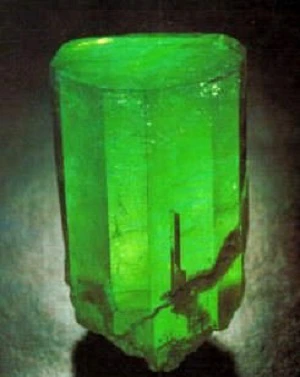
Guinness Emerald
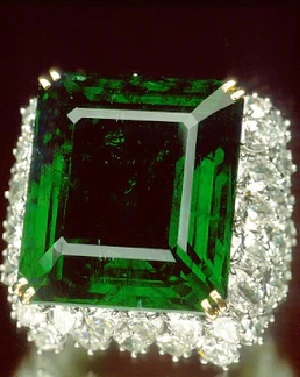
The Chalk Emerald
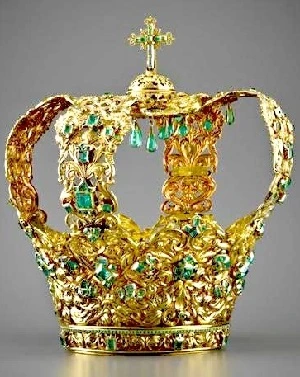
Crown of the Andes
Emerald Gemological Data
Colour: Emerald green, green, bluish-green, yellow-green.
Colour of Streak: White.
Moh`s hardness: 7.5 – 8
Density: 2.67 – 2.78
Cleavage: Indistinct.
Fracture: Small conchoidal, uneven, brittle.
Crystal system: Hexagonal prisms.
Transparency: Transparent to opaque.
Chemical composition: AI2Be3 [Si6O18] Aluminium beryllium silicate.
Refractive index: 1.565 – 1.602
Double refraction: -0.006
Pleochroism: Definite; green, blue-green to yellow-green.
Dispersion: 0.014
Fluorescence: Normally none.
For Researchers and Journalists
Recommended Citation (MLA) Format:
Hoyne, John. “Emerald: formation, history, meaning, and folklore.” Carus Jewellery, n.d., https://carusjewellery.com/emerald/.
You can also get in touch with Carusjewellery.com on Facebook , where you may leave any comments or questions you may have about this article.
