
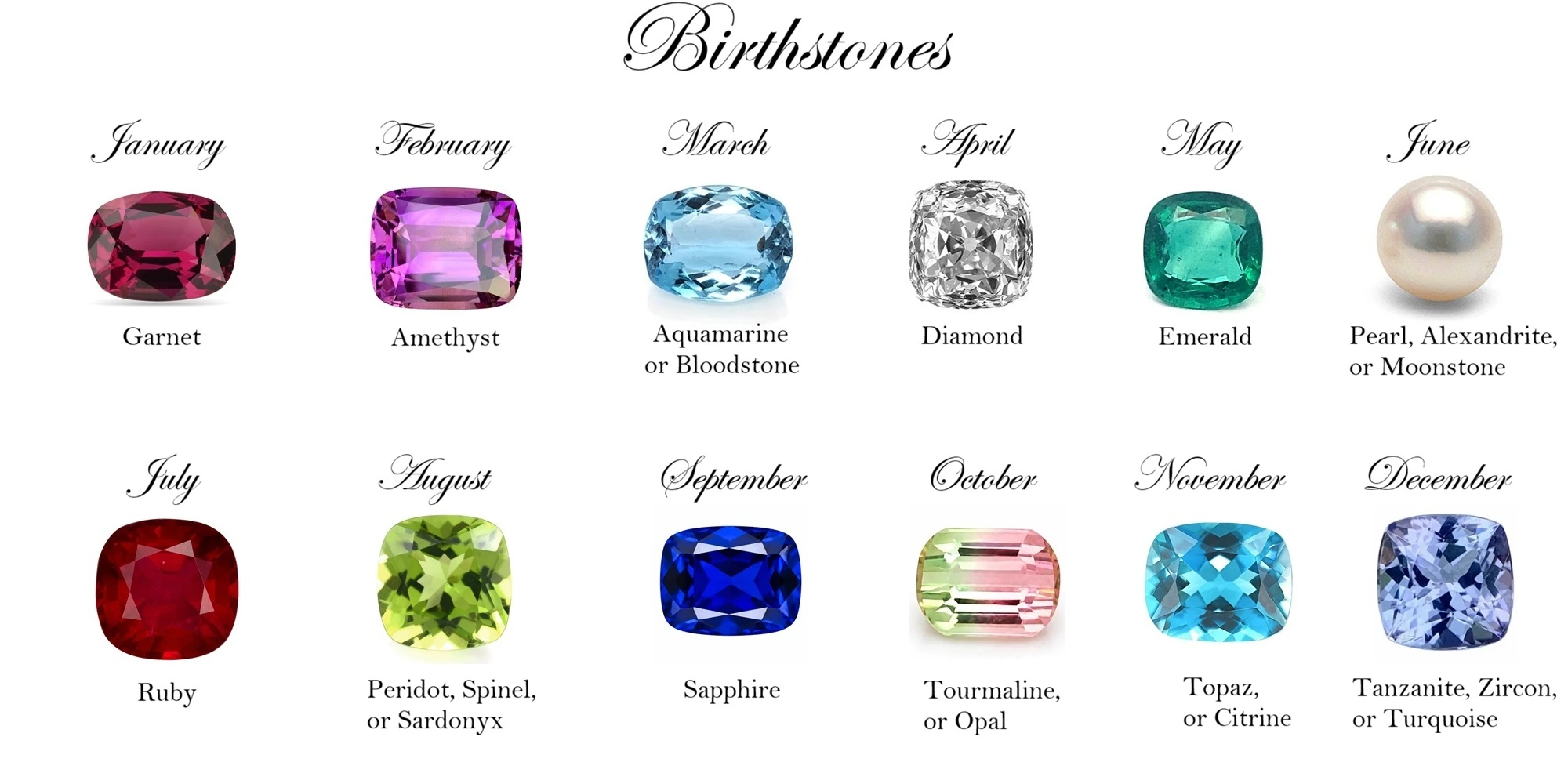
Birthstones

Flavius Josephus
Birthstones have a long and fascinating history, dating back thousands of years. Originally, these stones were worn as protective planetary talismans, based on the sun’s position throughout the year. Rather than as personal birthstones as we know them today. Birthstones are the assignment or alignment of a particular gemstone(s) to each month of the year and to the zodiac signs. As each gemstone has specific virtues, which are heightened at a particular month each year. The wearing of these stones during the correct month allows the greatest transfer of virtues from the stone to the wearer. This belief originated from the writings of Flavius Josephus in the 1st century. This talismanic wearing of these stones would continue until the end of the Middle Ages. After which the assigned monthly gemstone(s) began to be connected to the person’s birth month.
It should be noted that there are discrepancies within some old charts and some regional charts overlap, plus there has been historical translation errors, which explains why these charts tend to become so tangled. Also, the zodiac signs do not use the standard calendar months, they are based on the sun’s movements through the seasons. Each zodiac sign covers a thirty degree slice of the sky, as such they typically begin around the 19th to 22nd of each month. So when zodiac alignments are overlaid on our Gregorian Calendar mismatches can seem to appear.
Biblical Birthstone Chart
The origin of the Biblical Birthstone Chart comes from the Breastplate of Aaron. In the Book of Exodus, God commands Moses to create a sacred Breastplate for his brother Aaron, the High-Priest. This Breastplate held twelve gemstones set in four rows, with each gemstone engraved with the name of one of the twelve tribes of Israel. There has been some confusion to the exact names of these twelve gemstones because of ancient translation differences and variations used by different ancient authorities. The twelve gemstones of the Breastplate of Aaron, listed below, are generally considered accurate by historians.
High Priest’s Breastplate Gemstones
- Row 1: Sardius (or Carnelian / Ruby), Topaz, Carbuncle (or Garnet / Emerald).
- Row 2: Emerald (or Turquoise), Sapphire, Diamond (or Jasper / Lapis Lazuli).
- Row 3: Jacinth (or Ligure / Orange Zircon), Agate, Amethyst.
- Row 4: Beryl (or Chrysolite), Onyx, Jasper.
The earliest association of the twelve gemstones of the Breastplate with the months of the year is to be found in the “Antiquities of the Jews” by Flavius Josephus. Here Josephus writes:
“The two Sardonyxes that were in the clasps on the High Priest’s shoulders, indicate to us the sun and the moon. And for the twelve stones, whether we understand by them the months, or the twelve signs of what Greeks call the zodiac, we shall not be mistaken in their meaning.”
The above passage was adapted by St. Jerome, some three hundred years later, in the 5th century, when he wrote a letter to Fabiola. It was believed that these twelve gemstones held virtues and medicinal properties that were beneficial to people. Each gemstone was assigned its own month, during which these virtues and medicinal properties were heightened. At this time, the Book of Revelation became a subject of devout study. St Jerome stated that the Book of Revelation was the ultimate fulfillment of Christian Salvation and so the twelve foundation stones of the New Jerusalem largely took the place of the gemstones of the Breastplate. Each of these foundational stones was inscribed with the name of one of the apostles, since Judas Iscariot betrayed Jesus Christ, he was excluded from these foundational stones and was replaced by St Matthias.
St Jerome promoted owning all twelve of these gemstones and recommended wearing the appropriate one for each month. This practice became very popular with wealthy individuals during the Middle Ages, who would collect all twelve stones for this purpose. The practice of wearing a single birthstone throughout the year would not emerge until much later.
Foundation Stones of the New Jerusalem 12 Month Alignment (5th-15th century)
| Month | Gemstone | Assigned Apostle | Medieval Folklore |
|---|---|---|---|
| January | Jasper | St Peter | Wards off evil spirits, accidents and sorrow. |
| February | Sapphire | St. Paul | Symbol of God’s Divine Authority and Glory. |
| March | Chalcedony | St. Andrew | Banishes melancholy, wards off phantoms. |
| April | Emerald | St. John | Stone of morality, wards off demons, a healing stone. |
| May | Sardonyx | St. James the Less | Wards off vices and keeps the mind chaste. |
| June | Sardius | St. Philip | Imparts courage and vitality, wards off nightmares. |
| July | Chrysolite | St. Bartholomew | Wards off nightmares and demons when set in gold. |
| August | Beryl | St. Thomas | Imparts intelligence and marital bliss. |
| September | Topaz | St. Matthew | A cure for madness, calms anger, and a healing stone. |
| October | Chrysoprase | St. Thaddeus | Fosters good behaviour and brings peace. |
| November | Jacinth | St. Simon the Zealot | Protection from the plague and for safe travelling. |
| December | Amethyst | St. Matthias | Prevents drunkenness and promotes clear thinking. |
Traditional Birthstone Chart
It is not known exactly when the assignment of birthstones to birth months took place. It is thought to have developed in Central Europe during the 16th century. The Gemological Institute of America (GIA) has traced its development to Germany in the 1560s. Jean Henri Prosper Pouget, known as Pouget fils, who was a French Jeweller, states that in his opinion, the trend started in Germany, in his writings in 1762. While others claim that this trend started in Poland, when Jewish gemstone dealers began marketing individual gemstones using birth months. These Jewish gemstone dealers were said to be trying to move away from the “collect all twelve gemstones” and so open up the market to people that were less wealthy.
It should be noted that there were regional variations in this traditional birthstone chart, as it was not a unified chart.
Both Georgian Jewellery and Victorian Jewellery were quite sentimental and birthstones played a part in this. For example, acrostic jewellery was very popular and it was used to spell out a message to a loved one by using the first letter of each gemstone. So the message DEAREST would be spelt using Diamond, Emerald, Amethyst, Ruby, Emerald, Sapphire, and Topaz. Acrostic jewellery would also frequently include the use of the loved one’s birthstone, further personalising the jewellery. This Georgian Dearest Ring is a wonderful example of acrostic jewellery.
To capitalise on this sentimentality, in 1870, Tiffany & Co. published twelve birthstone poems known as the “Gregorian Birthstone Poems”. The poems themselves were published anonymously but it is widely thought that these poems were traditional folklore rhymes used as a clever marketing campaign.
Note: * “Zodiac Angels” and the modern “Birth Month Guardian Angels” actually originate from Renaissance mysticism and the occult, not Catholic Theology. The use of Gabriel’s name in this zodiac list has caused some considerable confusion. Michael, Gabriel, and Raphael are the only three angels named in the Bible.
Note: ** When these Gregorian Poems were used, they adapted the turquoise poem to fit December, by either changing that month’s gemstones or by changing the line of the poem “Place on your hand a turquoise blue;” to “Place on your hand a ruby true;”. This is also the case with September’s poem, which was originally sapphire but later on was adapted to chrysolite. I have included the original poems and so there are mismatches.
Traditional Birthstone Chart (16th century to 1912)
| Month | Gemstone(s) | Gregorian Birthstone Poem | * Zodiac Angel | Flower |
|---|---|---|---|---|
| January | Garnet | No gems save garnets should be worn By her who in this month is born; They will insure her constancy, True friendship and fidelity. |
Gabriel His talismanic gem: Onyx |
Snowdrop |
| February | Amethyst, Hyacinth, Pearl | The February-born may find Sincerity and peace of mind, Freedom from passion and from care, If she an amethyst wear. |
Barchiel His talismanic gem: Jasper |
Primrose |
| March | Bloodstone, Jasper | Who on this world of ours her eyes In March first opens may be wise, In days of peril firm and brave, Wears a bloodstone to her grave. |
Malchediel His talismanic gem: Ruby |
Daffodil, violet |
| April | Diamond, Sapphire | She who from April dates her years Diamonds should wear, lest bitter tears For vain repentance flow This stone Emblem of innocence is known. |
Asmodel His talismanic gem: Topaz |
Daisy |
| May | Emerald, Agate | Who first beholds the light of day In spring’s sweet flow’ry month of May, And wears an emerald all her life, Shall be a loved and happy wife. |
Amriel His talismanic gem: Carbuncle |
Hawthorn |
| June | Cat’s-eye, Turquoise, Agate | Who comes with summer to this earth, And owes to June her hour of birth, With ring of agate on her hand Can health, long life, and wealth command. |
Muriel His talismanic gem: Emerald |
Honeysuckle |
| July | Ruby, Onyx | The glowing ruby shall adorn All those who in July are born; For those they’ll be exempt and free From love’s doubts and anxiety. |
Verchiel His talismanic gem: Sapphire |
Water-lily |
| August | Sardonyx, Carnelian, Moonstone, Topaz | Wear a carnelian or for thee No conjugal felicity; The August-born without this stone, ‘Tis said, must live unloved, alone. |
Hamatiel His talismanic gem: Diamond |
Poppy |
| September | Chrysolite | **A maid born when September leaves Are rustling in the autumn breeze, A sapphire on brow should bind- ‘Twill cure diseases of the mind. |
Tsuriel His talismanic gem: Jacinth |
Morning-glory |
| October | Opal, Aquamarine, Beryl | October’s child is born for woe, And life’s vicissitudes must know; But lay a beryl on her breast, And hope will lull those woes to rest. |
Barbiel His talismanic gem: Agate |
Hops |
| November | Topaz, Pearl | Who first comes to this world below With drear November’s fog and snow Should prize the topaz’s amber hue- Emblem of friends and lovers true. |
Adnachiel His talismanic gem: Amethyst |
Chrysanthemum |
| December | Bloodstone, Ruby | **If cold December give you birth- The month of snow and ice and mirth Place on your hand a turquoise blue; Success will bless whate’er you do. |
Humiel His talismanic gem: Beryl |
Holly |
Gemstone of Week Days Chart
| Day | Gemstone | Weekday Poem | Talismanic Gem |
|---|---|---|---|
| Sunday | Topaz, Diamond | The bairn that is born On Sonnan’s sweet day Is blithe and is bonnie, Is happy and gay. |
Pearl |
| Monday | Pearl, Crystal | The bairn that is born Of Monan’s sweet race Is lovely in feature And fair in the face. |
Emerald |
| Tuesday | Ruby, Emerald | If Tuisco assists And at birth keeps apace, The bairn will be born With a soul full of grace. |
Topaz |
| Wednesday | Amethyst, Lodestone | But if Woden be there, Many tears will he sow, And the bairn will be born But for sadness and woe. |
Turquoise |
| Thursday | Sapphire, Carnelian | Jove’s presence at birth Means a long swathe to mow, For if born on Thor’s day Thou hast far, far to go. |
Sapphire |
| Friday | Emerald, Cat’s-eye | If Venus shall bless thee, Thou shalt bless many living; For Friga’s bairn truly Is loving and giving. |
Ruby |
| Saturday | Turquoise, Diamond | Seater-daeg’s bairn In sweat shall be striving, For Saturn has doomed it To work for a living. |
Amethyst |
Modern Birthstone Chart
In 1912, the National Association of Retail Jewelers convened in Kansas City to create a standardised modern birthstone chart. Before this, birthstone charts varied wildly depending on the region and even the availability of particular gemstones. This of course, did cause a lot of confusion amongst consumers. The other reason jewellers wanted a unified chart was to remove gemstones which they considered to be “archaic” and difficult to mass-produce. They wanted to replace them with brighter and more profitable gemstones. March’s bloodstone was replaced by aquamarine, which was brighter and easier to facet. June’s cat’s-eye, turquoise and agate were replaced by pearl, moonstone and with alexandrite being added in 1952. The main reason for this was that pearl was seen as the height of fashion and alexandrite was introduced as a prestigious gemstone. August’s sardonyx was replaced by peridot, this was mainly due to sardonyx being considered an old-fashioned and opaque gemstone. While peridot could be easily faceted and it provided a bright and lively sparkle. Tourmaline was added to October, this was mainly done to offer a more durable alternative to opal. Opal is a fragile gemstone and as such is only suitable for occasional wear, whereas tourmaline is durable enough for everyday wear, along with its ability to be faceted into a bright and lively gemstone. December’s lapis lazuli was replaced by zircon in 1952 and tanzanite was added later in 2002. This was to try and move away from opaque gemstones towards bright faceted stones.
While there was a need to create a unified chart, these so called “archaic” gemstones which were replaced, had incredible history and folklore attached to them, dating back thousands of years. Their history and folklore is deeply embedded in the human psyche, having been passed down through the generations. To replace such fundamental gemstones with more commercially profitable gemstones is questionable. An example of this would be tanzanite, which is a modern gemstone with virtually no folklore attached to it. Now going back through time, there have been various charts and various changes made to charts. However, all of these charts were essentially based either on the gemstones contained within the Breastplate of Aaron or on the gemstones of the Foundation Stones of the New Jerusalem in Revelation. This severing of Biblical ties for commercial purposes outraged traditionalists and historians alike. One of the most prominent opponents of the new chart was George Frederick Kunz, who spent many years researching and documenting the history and folklore of gemstones. He published his work titled “The Curious Lore of Precious Stones” in 1913. He was also the Chief Gemologist of Tiffany & Co. The resistance to this new birthstone chart did not end in 1912, it has continued to be a bone of contention to the present day.
Modern Birthstone Chart (1912 to Present)
| Month | U.S. (1912) | U.S. (2016) | UK (2013) |
|---|---|---|---|
| January | Garnet | Garnet | Garnet |
| February | Amethyst | Amethyst | Amethyst |
| March | Bloodstone, Aquamarine | Aquamarine, Bloodstone | Aquamarine, Bloodstone |
| April | Diamond | Diamond | Diamond, Rock Crystal |
| May | Emerald | Emerald | Emerald, Chrysoprase |
| June | Pearl, Moonstone | Pearl, Moonstone, Alexandrite | Pearl, Moonstone |
| July | Ruby | Ruby | Ruby, Carnelian |
| August | Sardonyx, Peridot | Peridot, Spinel, Sardonyx | Peridot, Sardonyx |
| September | Sapphire | Sapphire | Sapphire, Lapis Lazuli |
| October | Opal, Tourmaline | Opal, Tourmaline | Opal |
| November | Topaz | Topaz, Citrine | Topaz, Citrine |
| December | Turquoise, Lapis Lazuli | Turquoise, Zircon, Tanzanite | Tanzanite, Zircon, Turquoise |
Zodiac Alignment Charts
Foundation Stones of the New Jerusalem Zodiac Alignment Chart
(5th-15th Century)
| Foundation Order |
Gemstone | Zodiac Sign | Zodiac Date |
|---|---|---|---|
| First | Jasper | Aquarius | 20th Jan to 18th Feb |
| Second | Sapphire | Pisces | 19th Feb to 20th Mar |
| Third | Chalcedony | Aries | 21st Mar to 19th April |
| Fourth | Emerald | Taurus | 20th April to 20th May |
| Fifth | Sardonyx | Gemini | 21st May to 20th June |
| Sixth | Sardius | Cancer | 21st June to 22nd July |
| Seventh | Chrysolite | Leo | 23rd July to 22nd Aug |
| Eighth | Beryl | Virgo | 23rd Aug to 22nd Sept |
| Ninth | Topaz | Libra | 23rd Sept to 22nd Oct |
| Tenth | Chrysoprase | Scorpio | 23rd Oct to 21st Nov |
| Eleventh | Jacinth | Sagittarius | 22nd Nov to 21st Dec |
| Twelfth | Amethyst | Capricorn | 22nd Dec to 19th Jan |
Traditional Birthstone Zodiac Alignment Chart
(16th Century to 1912)
| Month | Gemstone | Zodiac Sign | Zodiac Date |
|---|---|---|---|
| January | Garnet | Aquarius | 20th Jan to 18th Feb |
| February | Amethyst | Pisces | 19th Feb to 20th Mar |
| March | Bloodstone | Aries | 21st Mar to 19th April |
| April | Sapphire | Taurus | 20th April to 20th May |
| May | Agate | Gemini | 21st May to 20th June |
| June | Emerald | Cancer | 21st June to 22nd July |
| July | Onyx | Leo | 23rd July to 22nd Aug |
| August | Carnelian | Virgo | 23rd Aug to 22nd Sept |
| September | Chrysolite | Libra | 23rd Sept to 22nd Oct |
| October | Beryl | Scorpio | 23rd Oct to 21st Nov |
| November | Topaz | Sagittarius | 22nd Nov to 21st Dec |
| December | Ruby | Capricorn | 22nd Dec to 19th Jan |
Modern Zodiac Birthstone Chart
(1912 to present)
| Zodiac Sign | Gemstone | Zodiac Date |
|---|---|---|
| Aries | Diamond | 21st Mar to 19th April |
| Taurus | Emerald | 20th April to 20th May |
| Gemini | Pearl | 21st May to 20th June |
| Cancer | Ruby | 21st June to 22nd July |
| Leo | Peridot | 23rd July to 22nd Aug |
| Virgo | Blue Sapphire | 23rd Aug to 22nd Sept |
| Libra | Opal | 23rd Sept to 22nd Oct |
| Scorpio | Topaz | 23rd Oct to 21st Nov |
| Sagittarius | Tanzanite, Turquoise | 22nd Nov to 21st Dec |
| Capricorn | Garnet | 22nd Dec to 19th Jan |
| Aquarius | Amethyst | 20th Jan to 18th Feb |
| Pisces | Aquamarine | 19th Feb to 20th Mar |
Tropical Zodiac, Astrological Talismanic System
(1st century to present)
| Zodiac Sign | Gemstone | Zodiac Date |
|---|---|---|
| Aries | Bloodstone | 21st Mar to 19th April |
| Taurus | Sapphire | 20th April to 20th May |
| Gemini | Agate | 21st May to 20th June |
| Cancer | Emerald | 21st June to 22nd July |
| Leo | Onyx | 23rd July to 22nd Aug |
| Virgo | Carnelian | 23rd Aug to 22nd Sept |
| Libra | Chrysolite | 23rd Sept to 22nd Oct |
| Scorpio | Beryl | 23rd Oct to 21st Nov |
| Sagittarius | Topaz | 22nd Nov to 21st Dec |
| Capricorn | Ruby | 22nd Dec to 19th Jan |
| Aquarius | Garnet | 20th Jan to 18th Feb |
| Pisces | Amethyst | 19th Feb to 20th Mar |
For Researchers and Journalists
Recommended Citation (MLA) Format:
Hoyne, John. “Birthstones – Biblical, Traditional and Modern Charts.” Carus Jewellery, n.d., https://carusjewellery.com/birthstones/.
You can also get in touch with Carusjewellery.com on Facebook , where you may leave any comments or questions you may have about this article.