
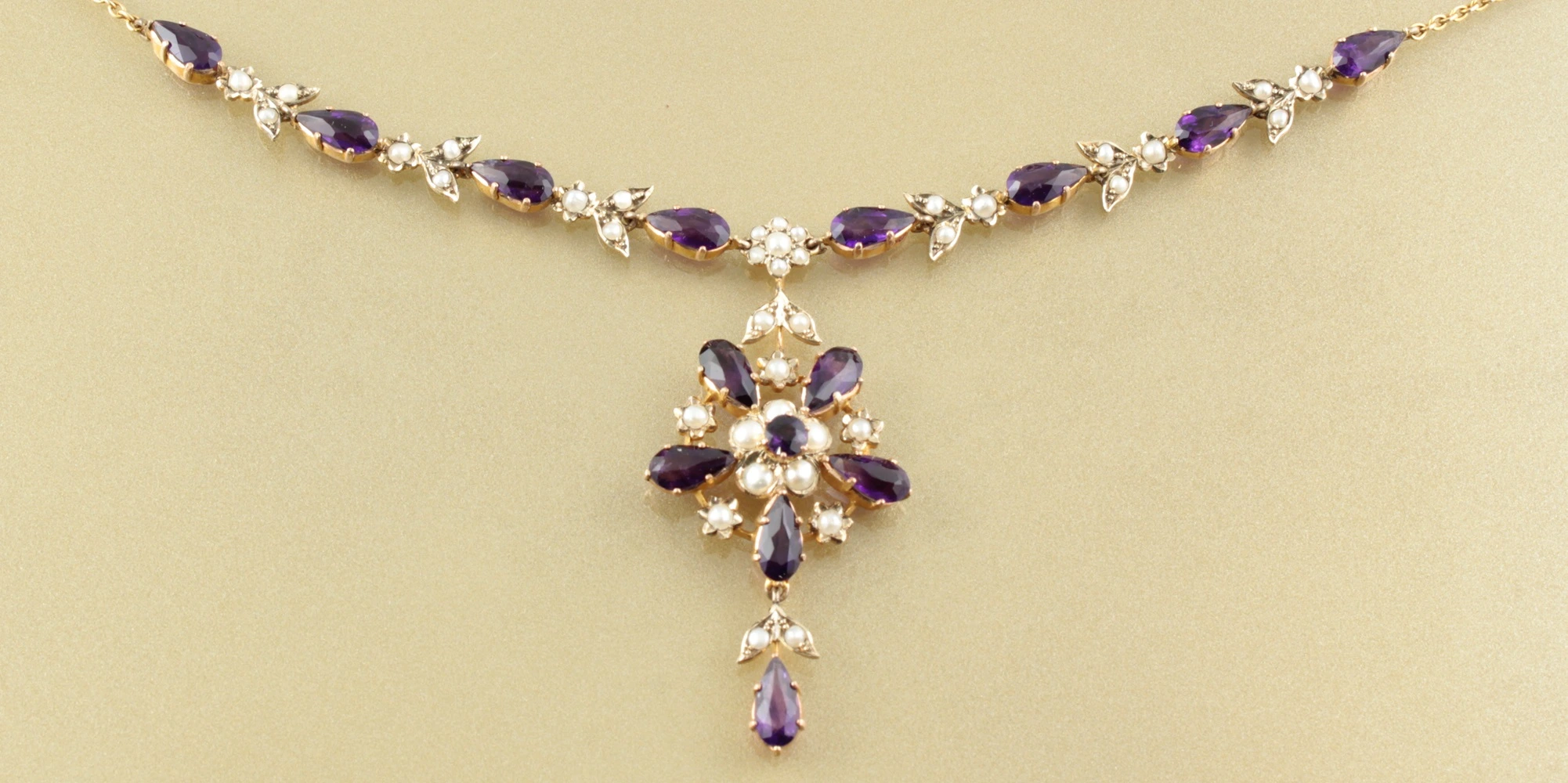
Amethyst
The name Amethyst is derived from the ancient Greek word “Amethystos” which is a combination of the Greek prefix”a-” meaning “not” and the word “Methysko” meaning “intoxicate”. So the name literally translates to “not intoxicate” or “not drunk”. This name came from the long-held belief the ancient Greeks had, that this gemstone could prevent the owner from becoming drunk.
Amethyst is a member of the Quartz group of minerals. Other well-known gemstones within this group include Agate, Jasper, Bloodstone, and Citrine. Its chemical composition is SiO2 silicon dioxide and it gets its colour from iron and other trace elements such as manganese. Naturally formed Amethyst only occurs in different shades of purple.
Amethyst Colour Variations
- Rose de France: This variation can range in colour from pale lavender to intense royal purple. This is the most commonly formed colour and will often contain colour zoning. Colour zoning is where a specimen will have lighter and darker coloured areas.
- Siberian: This variation has a deep and rich purple colour that will contain flashes or flickers of blue and red. The term “Siberian” is used to classify this colour variation and does not necessarily refer to the country of origin. Siberian quality is considered the most desirable and as such is the most valuable.
- Ametrine: Also called Trystine, this variation is a colour-zoned quartz variety. It consists of part Amethyst and part Citrine within the same crystal. A result of its formation, whereby part of the Amethyst was subjected to heat and so changed into Citrine. Deposits are found in Brazil and Bolivia.
- Raspberry: This variation has a reddish tint and is typically found in Arizona and in parts of Africa. It gets its reddish-purple colour from high concentrations of iron and manganese.
- Pink: This variation has a soft rose to peach colouration. It gets this colouration from inclusions of Hematite. It was only recently found in 2019, at the El Chiquada mine in Patagonia, Argentina.
- Chevron/Banded: Also called Amethyst Quartz. This variation consists of part Amethyst and part milky Quartz, which formed together in layers. The layers can form in a V shape which are called Chevron. The layers can also form in straight lines which are then called Banded. This variation is typically used as beads, cabochons and as baroque gemstones.
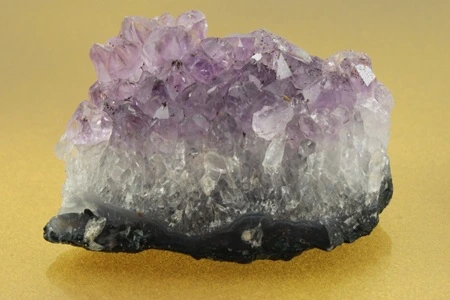 Formation: Amethyst is composed of silicon dioxide that contains iron impurities. The formation process starts with volcanic activity and as the lava begins to cool down, gas bubbles become trapped, forming hollow cavities. Silica-rich fluids containing trace amounts of iron then seep into these cavities, slowly over millions of years. As these fluids evaporate, crystals will begin to grow from the inside wall of the cavities towards its center, forming a geode. At this stage, the crystals will be colourless. Over millions of years, the host rock surrounding the geode emits low-level gamma radiation. This natural radiation then alters the trace amounts of iron in the crystal and so creating the purple colour. During this process, the final purple colour is determined by the temperature, pressure and the amount of iron present in the crystal.
Currently, the most significant deposits are located in Brazil, Madagascar, Zambia, Uruguay, Myanmar, India, Canada, Mexico, Namibia, Russia, Sri Lanka, and Arizona.
Treatment: The vast majority of Amethyst on the market is treated and treating is considered a standard industry practice, particularly heat treatment.
- Heat Treatment: Amethyst which has colour zoning (light & darker areas) can be heated to around 300°C, this will create a more uniform colour.
Very dark, almost black specimens can be heated to between 400°C to 600°C, which will lighten its colour and help to create the more desirable purple.
Purple Amethyst can be transformed into Citrine by heating it to between 470°C to 560°C.
Certain types of Amethyst, typically from Brazil, can be transformed into Prasiolite (green colour) by heating it to between 420°C to 500°C. - Irradiation: This treatment alters the iron content within the crystal and will deepen the stone’s purple colour. This treatment is not done as commonly as heat treatment.
- Surface Coating: For specimens with inclusions that reach the surface. A coating of polymer or resin can be applied, which will improve the gemstone’s clarity. It should be noted that gemstones which have received this treatment are more sensitive to heat and the use of ultrasonic cleaners is not recommended as it can damage the resin.
Durability: Amethyst has a hardness rating of 7 on the Mohs scale. So it is classed as suitable for everyday use. It also has no cleavage, meaning that it does not have a plane of weakness within its structure. Although it is a brittle gemstone, it has a toughness rating of good.
- Sunlight: Amethyst is sensitive to sunlight. Prolonged exposure to UV rays can cause its colour to fade.
- Heat: Amethyst is sensitive to thermal shock. Sudden extreme changes in temperature can cause it to crack. Very high heat (above 300°C) can cause permanent colour change.
- Chemicals: Amethyst is generally resistant to household chemicals and mild cleaning agents. However, it can be damaged by harsh chemicals.
- Storage: Even though this gemstone has a very good hardness and toughness rating. It can be scratched by harder gemstones such as Diamonds and it in turn can scratch softer gemstones such as Pearl. For that reason it is always best to store it in a separate compartment of your jewellery box, or to store it in a soft cloth pouch. If your Amethyst is set in silver, it is recommended to store it in an anti-tarnish pouch or to place a packet of silica gel with it when storing to help prevent tarnishing.
- Cleaning: The safest and most recommended way to clean your Amethyst jewellery at home is with warm soapy (mild) water and a soft toothbrush. Use the toothbrush gently so as not to catch its bristles in your jewellery settings which may dislodge the gemstone(s). Note: do not use toothpaste as it can contain abrasive particles which can leave microscopic scratches. The use of steam cleaners is not recommended since this gemstone is sensitive to thermal shock. The use of ultrasonic cleaners is generally considered safe unless the gemstone has inclusions or has been resin-treated.
Meaning and Healing Properties
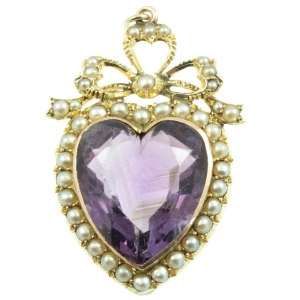
Amethyst symbolises sobriety, royalty and purity. The name itself literally translates to “not drunk”, the ancient Greeks and Romans believed that this gemstone could prevent drunkenness and maintain a sharp mind. Since the colour purple has always been associated with royalty, Amethyst became synonymous with royalty and power. Historically, it was also seen as a symbol of spiritual purity. In the Catholic Church, it was believed to bestow chastity, piety, and trust upon the wearer. Bishops would often wear an Amethyst ring to symbolise that they were wed to the Church. In more recent times, the gemstone is thought to help relieve stress and anxiety and to bring emotional balance to the wearer. This gemstone has also been credited with a number of healing properties. It is said to promote restful sleep and prevent nightmares if placed under your pillow. The stone is also said to help cure headaches and migraines, as well as boosting the wearer’s immune system.
Chakra: Amethyst is primarily associated with the crown chakra, which helps to promote spiritual connection and enlightenment. It is also associated with the third eye chakra, which helps to promote mental clarity.
Birthstone: Amethyst is the traditional birthstone for February.
Zodiac Astrology: Amethyst is primarily associated with the star sign Aquarius. It is also linked to the star sign Pisces.
Wedding Anniversary: Amethyst is the traditional gemstone gift for the 6th wedding anniversary.
History
Amethyst has a very long and fascinating history, dating back to around 25,000 BC. There is archaeological evidence from France along with other parts of Europe, showing that both Neolithic and Paleolithic people used this gemstone to make beads.
 The first organised mining of Amethyst took place at Wadi el-Hudi, which is in the Eastern Desert of Egypt. Mining took place there between 3,000 BC and 2,000 BC and was controlled by the pharaohs. This was large-scale and intensive mining, involving thousands of workers and a sophisticated supply network to bring food and water into the desert. During this time, Amethyst was exceptionally rare and very expensive. Since the pharaohs controlled the mining, it was considered a royal gemstone and was used to make official cylinder seals, along with jewellery for high-ranking individuals. The stone was often carved into heart-shaped and scarab-shaped amulets, as it was believed to hold protective powers. These amulets would also be buried with the deceased to help protect them in the afterlife during the “heart weighing” ceremony which was said to determine their fate. During this time, Egypt was also a significant exporter of Amethyst across the Mediterranean and to the East.
As the Wadi el-Hudi Amethyst mines became largely depleted. India and Sri Lanka became the world’s primary sources of the gemstone for the next 1,500 years. Amethyst was mined from riverbeds across the Indian subcontinent and traded with Rome in exchange for gold. It was transported via the Silk Road, through Persia and Central Asia to the Mediterranean. It was also transported via the Red Sea route, which went from India to Egypt and then on to Rome. Trade in this gemstone was extensive, archaeologists have found Indian sourced Amethyst as far away as North Yorkshire, where it was used in Anglo-Saxon jewellery and Roman seal rings. In Sri Lanka, Ratnapura was the main mining area. Deposits were mostly found in river gravels and like India, were traded with the Roman Empire.
During the middle-ages, Europe did have some small deposits in Idar-Oberstein in Germany and at Maissau in Austria.
In 1668, two brothers Dmitry and Mikhail Tumashev found coloured stones near Yekaterinburg on the Eastern Slopes of the Ural Mountains. They reported their find to Moscow and were given a reward. After this in 1700, Peter I issued a decree allowing anyone the right to search for gemstones. This of course led to a gem rush and the richest deposits were found in the Murzinka-Aduy belt. Which is a 100 km long strip of land near Yekaterinburg. Amethyst from this area was of exceptional quality and was referred to as “Siberian Amethyst”. It was highly prized for its deep rich purple colour that would change to a red wine colour under incandescent light. Up until the 19th century, Amethyst was classed as a “Cardinal Gemstone” (precious gemstones) and considered of equal value to diamond. At this time, the five “Cardinal Gemstones” were Diamond, Emerald, Ruby, Sapphire, and Amethyst.
However, this was to change in the early 19th century. When massive deposits were discovered in Brazil by settlers from the famous Idar-Oberstein gem-cutting centre in Germany. The deposits of Amethyst in Brazil contained truly impressive geodes, some were reportedly large enough for a person to stand inside them. Later on in the 1870s, deposits were also discovered in the Artigas region of Uruguay. Which produced deep rich purple Amethyst of a very high quality. These new deposits flooded the market and caused a dramatic collapse in the price of Amethyst. As a result, Amethyst was no longer classed as a cardinal gemstone and so was re-classed as a semi-precious gemstone.
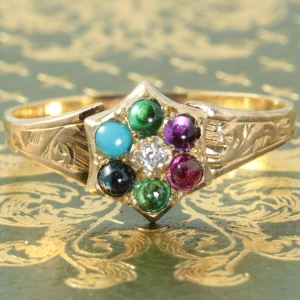 During the Victorian Era, Amethyst suddenly became affordable and widely available. It became very fashionable and full parures of matching Amethyst jewellery were all the rage. It also became widely used in “ACROSTIC” jewellery. Acrostic jewellery spells out a message or word, using the first letter of each gemstone. For example, a popular and romantic word was DEAREST spelled using Diamond, Emerald, Amethyst, Ruby, Emerald, Sapphire, and Turquoise.
Amethyst became a firm favourite during the Arts & Crafts movement. Designers and artisanal jewellers often preferred to use this gemstone as a cabochon and to set it in silver. As opposed to earlier times, when setting in heavy gold was preferred.
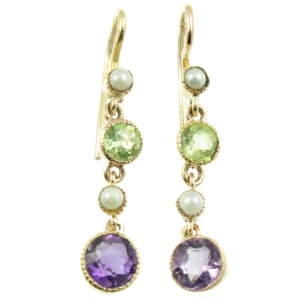
During the Suffragette movement, which started in the early 1900s. Amethyst was used in Suffragette jewellery to represent “Dignity”. The Suffragette colours were: Green for Hope (Peridot or Emerald), White for Purity (Pearl or Moonstone), and Violet for Dignity (Amethyst).
Folklore
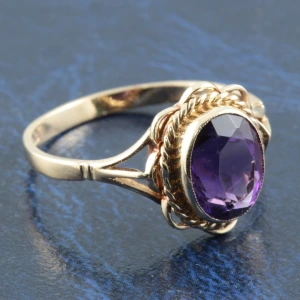 The ancient Egyptians called Amethyst “Hemag” and believed it was a powerful talismanic gemstone which could protect them from both physical and spiritual harm. They would wear the stone in the belief that it would protect them from witchcraft and evil spirits. Warriors wore it into battle believing it offered protection and that it could increase their courage. The stone was also believed to offer protection in the afterlife. It was specified in the book of the dead, that Amethyst should be carved in the shape of a heart and buried with the dead. This heart-shaped Amulet was said to help the deceased in the “weighing of the Heart” ceremony which took place in the afterlife.
Greek Mythology: The ancient Greeks associated Amethyst with Dionysus, god of wine, revelry, and ritual madness. Legend has it that Dionysus was insulted by a mortal and in a rage, he swore to unleash his tigers on the next mortal he saw. The next mortal he came across was Amethystos, a beautiful young woman who was making a pilgrimage to the shrine of Artemis (Diana), goddess of the hunt and protector of young maidens. As Dionysus’s tigers lunged at Amethystos, Artemis intervened to protect her by turning her into a statue of pure white quartz. When Dionysus realised that he had destroyed the life of an innocent young woman. He was said to have cried tears of wine over the statue, staining it purple and so creating Amethyst. Since the Greeks believed that this gemstone was formed from wine and Dionysus’s regret, they believed it held the power to prevent drunkenness. The Greeks would drink wine in goblets made from Amethyst or hold the gemstone under their tongue to prevent drunkenness. They also believed that the stone could help the wearer to keep a clear head in business.
Roman Mythology: The ancient Romans associated Amethyst with Bacchus, god of wine and revelry, similar to the Greek Dionysus and its story. As such the Romans mirrored the same beliefs as the Greeks and believed it could prevent drunkenness.
Since this gemstone was purple and very expensive at the time, it was regarded as a status symbol and worn by the nobility. They would also wear it as a talisman in the belief that it could protect them from harm and evil. The stone was also believed to bring success in war and that its virtues could be increased if the stone was set in copper.
One of the most famous stories about Amethyst from this time comes from Saint Valentine. During the 13th century, the Roman Emperor Claudius II issued a decree banning young men from getting married. As he believed that married men made poor soldiers because they did not want to leave their wives and children. However, Saint Valentine chose to defy the Emperor and would perform secret weddings. He wore an Amethyst signet ring with the image of Cupid engraved on it. This ring was then used by young couples to recognise him. Eventually, he was discovered and arrested, he was then given the opportunity to renounce his faith. If he did so, then he was to be set free and allowed to keep his wealth. He kept to his faith and so he was executed on February 14th 269 AD.
Medieval Europe: During the middle-ages in Europe, Amethyst held deep significance for the Catholic Church. It was said to bestow chastity, piety and trust upon the wearer. Bishops would often wear an Amethyst ring to symbolise their purity and celibacy as well as a symbol that they were married to the Church. This led to the stone being called the “Bishop’s Stone”. There was widespread belief at the time that the stone could protect the wearer from witchcraft and demonic attacks. Medieval knights wore the stone in the belief that it could increase courage and it could offer protection in battle. They also believed it had a calming effect on the wearer and so they would have a clear head in battle.
During the Renaissance period and later, there was a renewed interest in engraved gemstones. In the “Book of Wings” by Ragiel (13th Century), each gemstone is assigned a different image, which was to be engraved while performing a ritual. This would then enchant the gemstone, making its original virtues even stronger. In the case of Amethyst, the book of wings details the following:
“A bear, if engraved on an Amethyst, has the virtue of putting demons to flight and defends and preserves the wearer from drunkenness”
Famous Amethyst
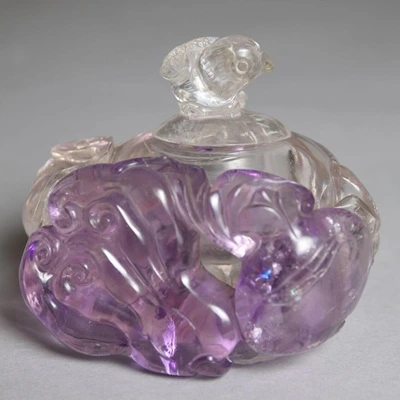
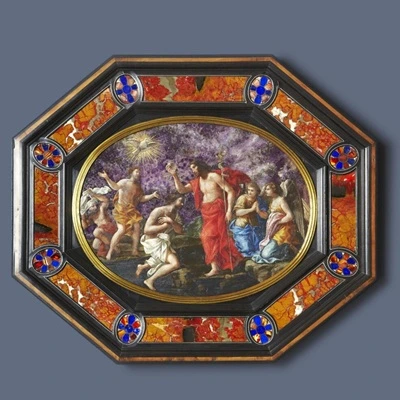
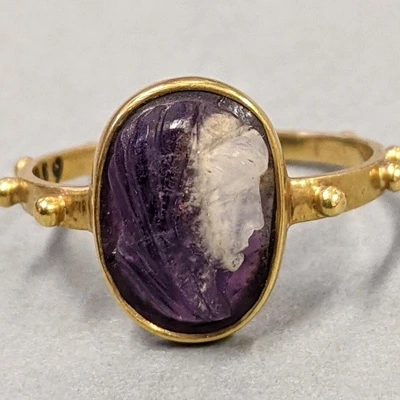
The above pieces of Amethyst are on display at the V&A Museum.
Amethyst Gemological Data
Colour: Purple, violet, pale red-violet.
Colour of Streak: White.
Moh`s hardness: 7
Density: 2.65
Cleavage: None.
Fracture: Conchoidal, very brittle.
Crystal system: Trigonal, hexagonal prisms.
Transparency: Translucent to transparent.
Chemical composition: SiO2 silicon dioxide.
Refractive index: 1.544 – 1.553
Double refraction: +0.009
Pleochroism: Dichroic, weak; reddish-violet, grey-violet.
Dispersion: 0.013
Fluorescence: Typically inert, weak: blueish.
For Researchers and Journalists
Recommended Citation (MLA) Format:
Hoyne, John. “Amethyst: Formation, History, Meaning, and Folklore.” Carus Jewellery, n.d., https://carusjewellery.com/amethyst/.
You can also get in touch with Carusjewellery.com on Facebook , where you may leave any comments or questions you may have about this article.