
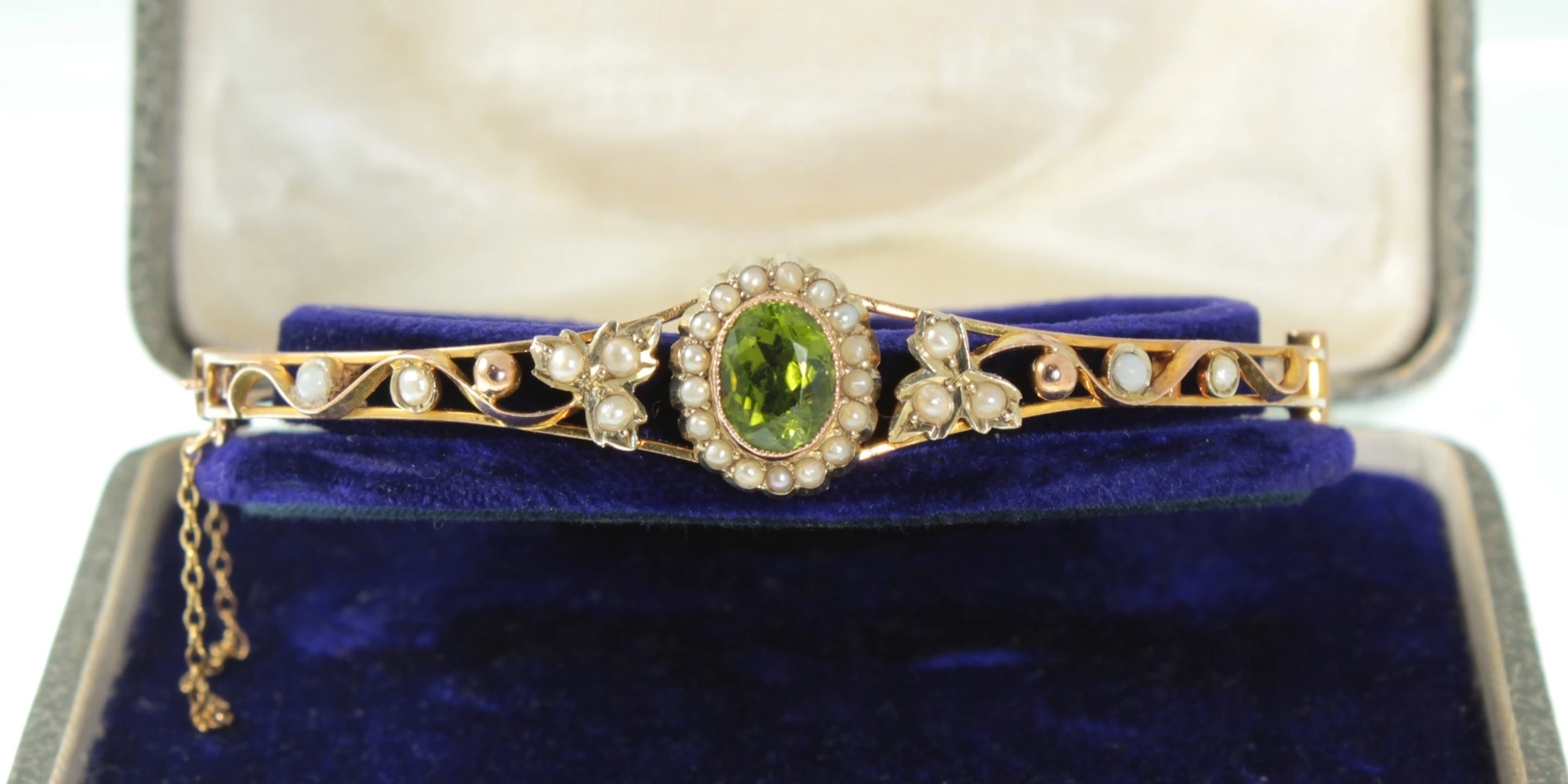
Peridot
The name Peridot is most likely derived from the Arabic word ‘faridat’ which means gem. Historically, this stone was called Chrysolite, which is Greek for ‘Gold Stone’. Chrysolite was also used to name various other yellow-green stones, such as Topaz, Tourmaline and yellow Berly. In mineralogy, Peridot is part of the mineral group Olivine because of its olive-green colour. Only Olivine that is of gemstone quality is called Peridot. This stone is an idiochromatic gemstone, which means that it gets its colour from the iron content rather than impurities. As such its colour ranges in shades of green from yellow-green to olive-green to lime-green, grass-green and brownish-green. The most valuable colour is pure grass-green with no hint of yellow or brown. Brownish-green is considered to be lower-quality and as such is the least valuable.
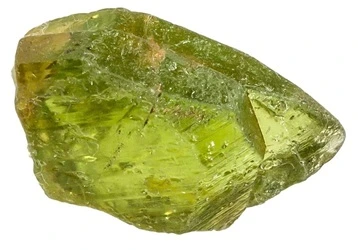 Formation: Peridot forms in the Earth’s upper mantle, at a depth of about 20 – 55 miles beneath the Earth’s surface. It is one of only two gemstones which form in the Earth’s mantle under such extreme heat and pressure, the other is Diamond. It forms within magma chambers which are rich in magnesium and iron. As the magma begins to cool down slowly, Peridot begins to crystallise and sink to the bottom of the chamber. Where it will remain until it is brought to the surface by geological forces. Such as a volcanic eruption, when it will be spewed out within the host rock typically basalt. It can also be brought to the surface by tectonic uplift, when tectonic plates collide. Tectonic uplift has brought this gemstone to the surface in such places as Pakistan and the Island of Zabargad (St. John’s Island). Peridot is also formed in space, specifically in pallasite meteorites. In 1749, a meteorite fell in eastern Siberia which contained Peridot. The majority of the meteorite is currently housed in the Fersman Mineralogical Museum in Moscow.
Treatment: Peridot is rarely treated, since it naturally has excellent clarity and a vibrant green colour. However, there are a few treatments which can be applied in rare cases.
- Oil/Resin Filling: To fill small cracks and to improve the stone’s clarity it can receive a coating of oil or wax. This treatment is not permanent and will need to be reapplied occasionally. An epoxy resin such as Opticon can be used instead of oil or wax and is more durable. However, heat or ultrasonic cleaners can damage such resins.
- Surface Coatings: To increase the brilliance and depth of colour, a metal foil backing can be applied to the stone. This is a technique which was commonly applied to gemstones during the Georgian Era.
Durability: Peridot has a hardness rating of 6.5 to 7 on the Mohs scale of hardness. Which makes it moderately durable, for everyday wear a rating of 7 or above is recommended. As such this gemstone is more suitable for occasional wear. However, more protected jewellery such as necklaces and earrings could be worn more frequently.
Sunlight: Under normal conditions, Peridot is considered sunlight stable.
Heat: This gemstone is very sensitive to heat. Rapid changes in temperature can cause thermal shock. Resulting in the stone cracking or developing internal fractures. As such it should be stored away from any direct sources of heat. Note: Since this stone is heat sensitive, you should never clean it with a steam cleaner or in an ultrasonic cleaner.
Chemicals: Peridot is sensitive to acids. As such contact with household cleaners, hairspray, makeup and perfumes should be avoided. It is recommended to put on your jewellery after you have applied any cosmetics or perfumes.
Storage: Since this stone has a moderate hardness rating, it is recommended to store it in a soft cloth pouch to avoid contact with other jewellery which may scratch it.
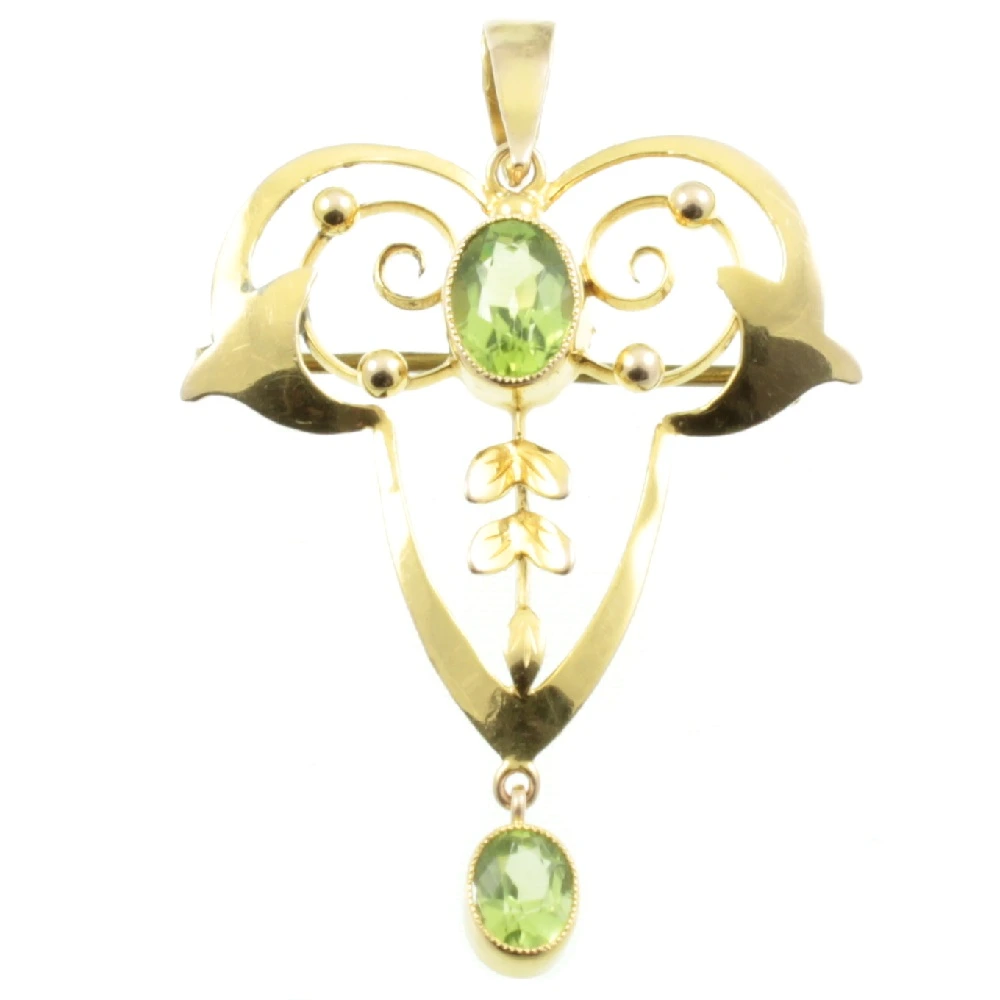
Meaning and Healing Properties
Throughout time, Peridot has symbolised prosperity, rebirth and nature. This gemstone was also known as the ‘Stone of Compassion’. It was said to stabilize the wearer’s mood and to alleviate stress, it helps to reconcile broken friendships by releasing feelings of jealousy, guilt and resentment. The stone is associated with prosperity and is believed to attract both wealth and success. It has also been called the ‘Study Stone’ and was said to improve focus and mental clarity, allowing the wearer to learn new things more easily. The ancient Egyptians called this gemstone ‘Gem of the Sun’. They believed the stone had protective powers, particularly to prevent the wearer from having nightmares and to ward off evil spirits. This protective power could be increased if the stone was set in gold. This gemstone has also credited with a number of healing properties. It was used to treat ailments of the liver, gallbladder and to aid digestion.
Chakra: Peridot is associated with the heart chakra, which helps promote love and compassion. It is also associated with the solar plexus, which helps promote willpower and self-worth.
Birthstone: Peridot is the traditional birthstone for August, along with Sardonyx and Spinel.
Zodiac Astrology: Peridot is associated with the star sign Leo and Virgo.
Wedding Anniversary: Peridot is the traditional gemstone gift for the 16th wedding anniversary, symbolising good health, harmony and peace.
History
The earliest known mining of Peridot was on Zabargad Island (formerly called Topazios or St. John’s Island) in the Red Sea. Mining activity there dates back over 3,500 years and historically, it was the world’s primary source. The Egyptian pharaohs controlled the island and the mining there. Legend has it that they jealously guarded the island and would kill any unauthorised persons who approached it. The island was extensively mined during the Hellenistic, Roman and Medieval periods. During the Medieval period, the island was known as the ‘Isle of Serpents’.
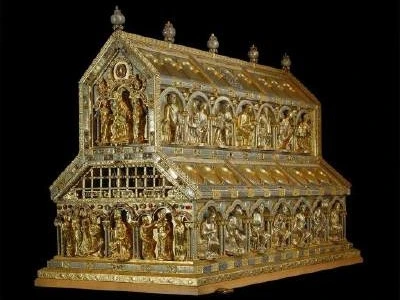 The crusaders introduced Peridot to Europe between the 11th and 13th centuries. Some of which may have been from trade and some may have been as the result of looting. During the 12th century, crusaders did conduct raids in the Red Sea and it is quite likely some gemstones were acquired during the looting of port cities such as Aydhab. These gemstones were mistaken for Emeralds and were often referred to as ‘Emeralds of the Crusades’. Some famous examples brought back by the crusaders can be found in the Shire of the Three Kings in Cologne Cathedral. Which contains several large gems each weighing over 200 carats.
The location of Zabargad Island was lost to time during the middle-ages and was not rediscovered until 1905. Mining did resume there and peaked during the 920s and the 1930s. The Egyptian government did nationalised the mines in 1958. However, by that time the mines were largely depleted.
In the 1940s, major new deposits were found on the San Carlos Apache Indian Reservation in Arizona. Currently, these deposits account for 80% to 95% of global supply.
In 1994, deposits were found in the Himalayas in Pakistan. Referred to as ‘Kashmir Peridot’, they are considered to be of the finest quality ever discovered.
Other deposits are located in Myanmar, Australia, Brazil, China, Kenya, Mexico, Sri Lanka, South Africa and Tanzania.
Folklore
The ancient Egyptians were the first known people to record the use of Peridot. They associated the stone with Ra, the sun god and called it the ‘Gem of the Sun’. The stone is also associated with Isis, goddess of motherhood, fertility and healing. In some Egyptian mythological scenes, the god Horus is depicted wearing a Peridot headdress. The Egyptians revered the stone as sacred and powerful. It was worn as a talisman to ward off evil spirits and nightmares. It was also believed to bring the wearer good luck and prosperity. To use the stone for protection against evil spirits and nightmares, the stone had to be pierced and strung on the hair of a donkey and then attached to the left arm. To exert its full power, the stone was required to be set in gold. This was particularly the case when the stone was to be used to dispel night terrors. The Egyptians also believed the stone held healing properties, high priests would crush it into a fine powder to make potions to treat various ailments.
Greek Mythology: The ancient Greeks called the stone ‘Chrysolite’ which means ‘Gold Stone’. They associated the stone with Aphrodite, goddess of love, beauty and fertility. There are also some Greek legends which link the gemstone to Zeus and referred to it as a stone of divine authority. In these legends, it was said that if a Peridot was blessed by Zeus then the stone would protect the wearer from betrayal. The Greeks believed that the stone could grant the wearer eloquence and the power of persuasion, as such it was frequently worn by public speakers. It was thought to have the power to cure madness and relieve depression. They also believed the stone had the ability to make them prosperous and could improve their social status. The Greek historian wrote about the island of Topazios (Zabargad), saying that the island was hidden by a perpetual fog and only those with divine favour could find their way through the fog to find the island and the glowing gems.
Roman Mythology: The ancient Romans prized Peridot because it did not fade or darken in low light, crediting it with an inner light. They frequently called this gem ‘Emerald of the Evening’ mistaking it to be Emerald. In Roman mythology, the stone was associated with Venus, goddess of love and gardens. Believing the stone brought harmony to domestic life and growth to plants. The stone was also associated it with Apollo, god of light, music and prophecy. They believed that the wearer of the stone would be granted the clarity of sunlight by Apollo and so be able to see the truth. The Romans used the stone as a powerful talisman to counter against sorcery and to ward off evil spirits. Like the Egyptians, the Romans believed that the stone needed to be set in gold to unlock its full power. They noted that if the stone was set in silver or copper, then the stone’s abilities were limited. Roman physicians would recommend wearing the stone for ailments of the mind. They believed it could calm a racing mind and cure insomnia.
Medieval Europe: In medieval Europe, the stone was still being called Chrysolite and it was revered as a stone of divine protection and spiritual insight. Since the stone remains bright even in low light, it was said to have an inner light which symbolised the light of God. It was widely believed to be a powerful protective stone, particularly against witchcraft and evil spirits. It was also believed to have prophetic properties, allowing the person to see visions if they gazed into the stone. The stone was also used for medicinal purposes. It would be ground into a fine powder and made into a potion which was said to cure asthma and reduce fever.
A vast amount of Peridot was brought back to Europe by the returning crusaders from the Middle East. It was widely used by the Catholic Church to decorate religious objects. The stone was even used to decorate vestments of high-ranking clergy, symbolising purity and divine authority.
There was widespread belief that Peridot promoted good friendships and protected against betrayal. As such, it was frequently given as diplomatic gifts.
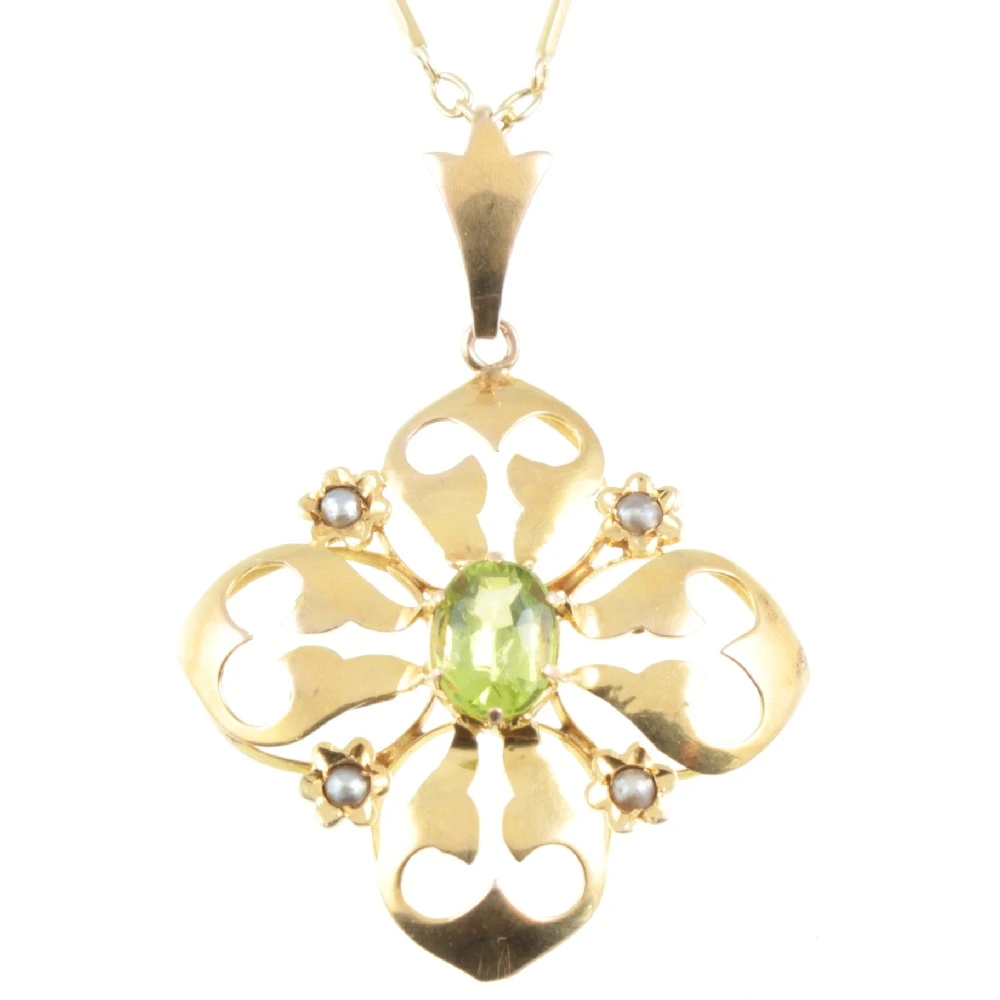
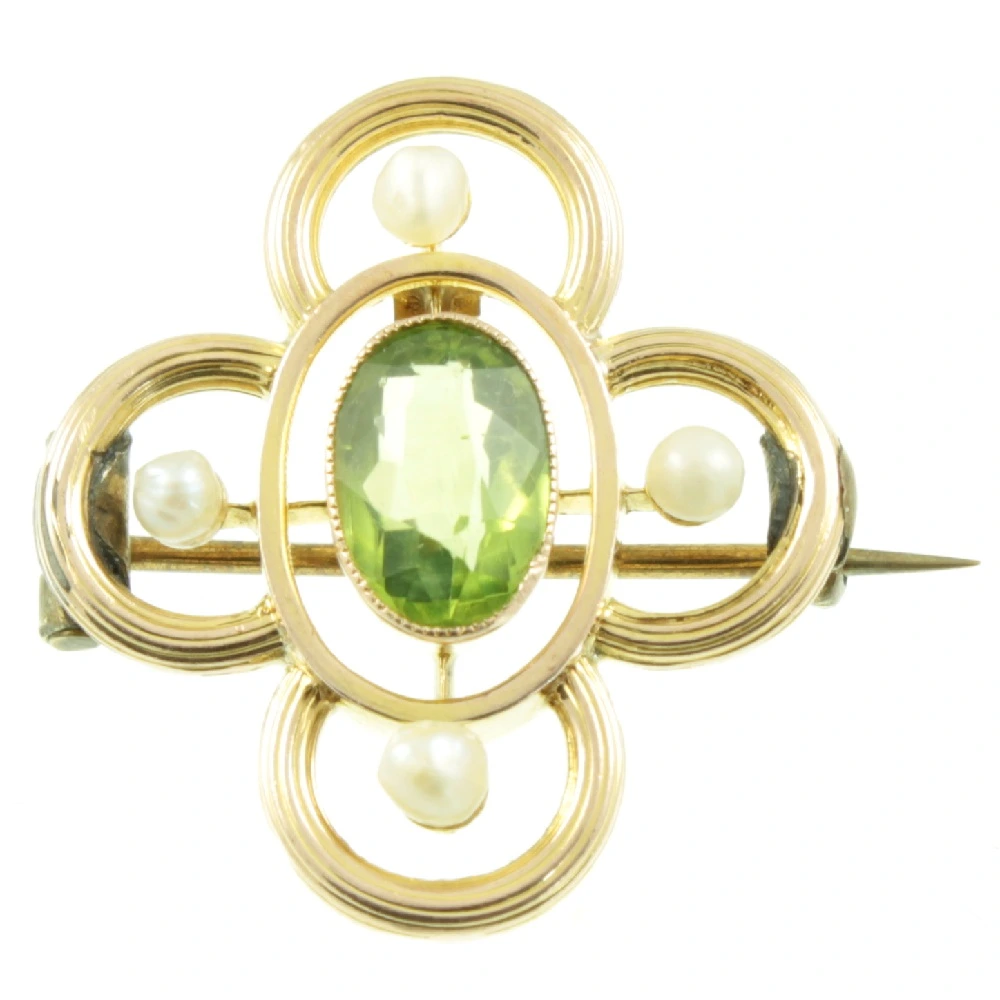
Famous Peridot Jewellery
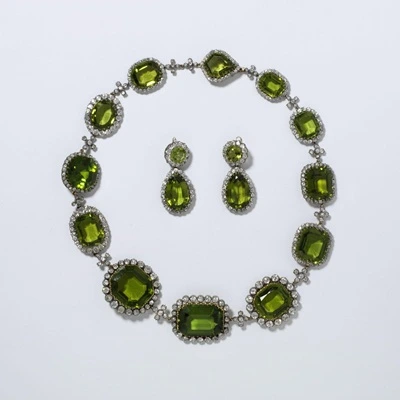
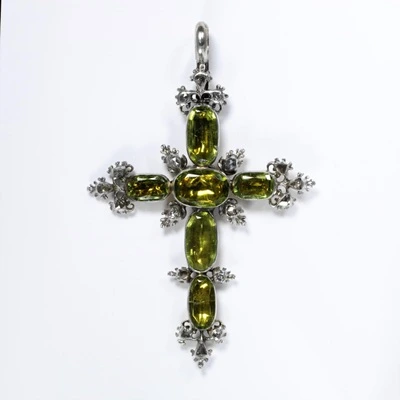
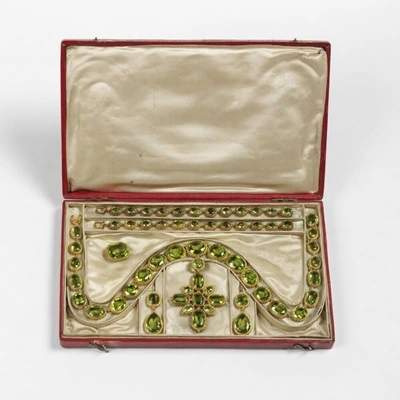
The above pieces of Peridot Jewellery are on display at the V&A Museum.
Peridot Gemological Data
Colour: Yellow-green, olive-green, brownish.
Colour of Streak: White.
Moh`s hardness: 6.5 – 7
Density: 3.28 – 3.48
Cleavage: Indistinct.
Fracture: Brittle, small conchoidal.
Crystal system: Orthorhombic; short compact prisms, vertically striated.
Transparency: Transparent.
Chemical composition: (Mg,Fe2+)2[SiO4] magnesium iron silicate.
Refractive index: 1.650 – 1.703
Double refraction: +0.036 to +0.038
Pleochroism: Very weak; colourless to pale green, lively green, olive-green.
Dispersion: 0.020 (0.012-0.013)
Fluorescence: None.
For Researchers and Journalists
Recommended Citation (MLA) Format:
Hoyne, John. “Peridot: Formation, History, Meaning, and Folklore.” Carus Jewellery, n.d., https://carusjewellery.com/peridot/.
You can also get in touch with Carusjewellery.com on Facebook , where you may leave any comments or questions you may have about this article.
