
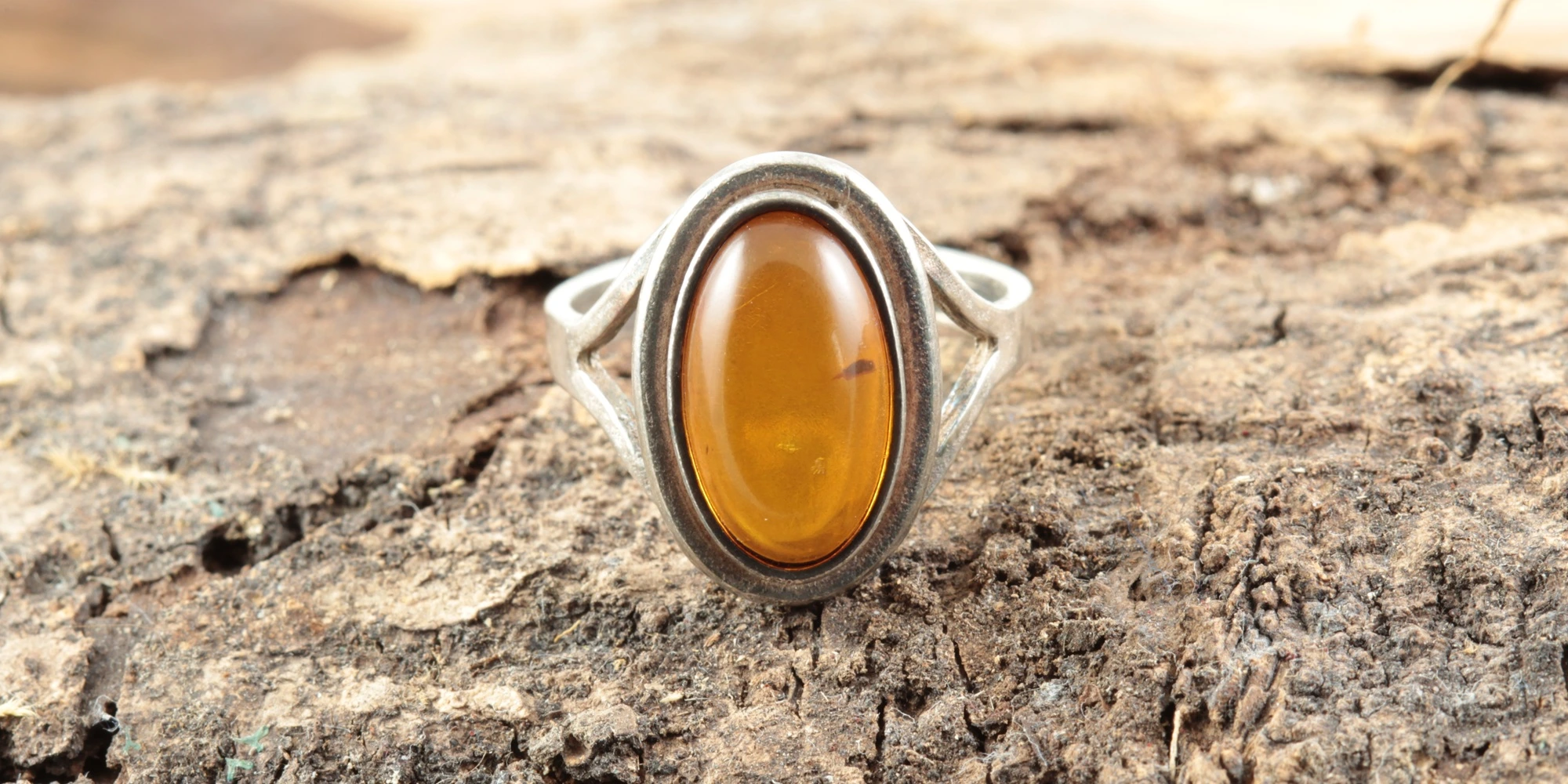
Amber
The name Amber is derived from the Arabic Word “Anbar”, the word “Anbar” originally referred to Ambergris. Ambergris is a waxy, fragrant substance which comes from sperm whales. Since both Ambergris and Amber were frequently found washed up on beaches, they became associated and or confused. During the 14th century, a distinction was made between them, Amber was called “Yellow Amber” and Ambergris was called “Grey Amber”.
This gemstone is composed of tree resin and as such is classed as an organic gemstone. Other well-known gemstones in this group include Coral, Jet and Pearl. Amber comes in a wide variety of colours, it has been estimated that there are over 250 different shades. Of these, there are seven main colour categories.
Main Colour Categories
Common colours
- Yellow/Golden: This is by far the most common colour and accounts for about 70% of all natural deposits. It ranges in colour from pale lemon to rich honey.
- Orange/Brown: This colour is often times, the result of the resin mixing with earth or bark before it is fossilised. This colour would account for about 10% of all natural deposits.
- Black: This black colour is typically a very dark brown or red that will appear to be black because of the high percentage of organic matter which is trapped within it. Black would account for about 15% of all natural deposits.
Rare colours
- Green: This colour typically forms when resin comes into contact with green plants and reacts with chlorophyll. It ranges in colour from a light olive green to a dark forest green. Green would account for about 2% of all natural deposits.
- White: This colour is also called “Royal” or “Bone”. It is formed when millions of tiny air bubbles become trapped within it. This is normally a milky white colour and it would account for about 1% to 2% of all natural deposits.
- Red/Cherry: This colour is also called “Dragon’s Blood” and is typically formed by natural oxidation over millions of years. This colour is very rare and it would account for about 0.5% of all natural deposits.
- Blue: Blue amber is extremely rare and it has a colour-changing ability. In sunlight, it appears a vivid blue colour and under incandescent light, it appears golden to brown in colour. It is formed as a result of volcanic activity or from forest fires. This is primarily found in the Dominican Republic and it would account for about 0.2% or less of all natural deposits. This colour is considered the most valuable of the colours.
Clarity and Inclusions
Clarity and inclusions are important factors in determining the value of a piece of Amber. The clarity grading scale is from AAA to E and is based on the percentage of inclusions or the transparency. A high transparency is more desirable for jewellery and will showcase the interior best. As the percentage of inclusions increases, the value will decrease. A common form of inclusions is caused by air bubbles, this results in a milky or cloudy appearance which is commonly referred to as “Bone” or “Bony”. Amber with a high transparency that contains a recognisable object such as an insect, a plant or pyrite etc, is highly prized and worth a significant amount of money. It should be noted that blue Amber has its own clarity grading scale, from AAA to C, with the AAA grade, being cobalt blue.
Clarity grading scale
- AAA: This represents stones which are 100% free of all inclusions and are clear/transparent.
- AAB: This represents stones which are totally opaque and with a solid, uniform colour throughout.
- A: This represents stones which contained about 15% inclusions. This is considered lightly included.
- B: This represents stones which contain between 15% to 35% inclusions. This is considered moderately included.
- C: This represents stones which contain between 36% to 60% inclusions. This is considered heavily included.
- D: This represents stones which contained between 61% to 99% inclusions. This grade is considered extremely included.
- E: This represents stones which are completely included and often have the appearance of a mass of organic matter.
Geographical Origins
Amber is also classified by its geographical origin. Since it can form from different trees in different prehistoric climates and at different time periods. It will have a unique composition and physical properties specific to each location. Outlined below are the main regions that produce jewellery quality Amber.
Baltic Amber: This variety is sourced in northern Europe and is estimated to be 44 million years old. Often called “True Amber” or “Succinite, this is the best known variety and the most abundant. This variety also has a strong association with traditional medicine.
Dominican Amber: This variety is sourced in the Caribbean and it is estimated to be 15 to 20 million years old. Rare blue and green varieties are primarily sourced from here. This variety is also highly prized for its exceptional transparency.
Burmese Amber: This variety is sourced from Myanmar and is estimated to be 100 million years old, making it one of the oldest varieties on the market. This is harder than other varieties and is known for containing the rare prehistoric inclusions.
Mexican Amber: This variety is sourced from Chiapas and is estimated to be 24 million years old. It is typically transparent and golden to reddish-brown in colour. This variety is known for containing inclusions of insects, plant fragments and even small aquatic creatures.
Formation
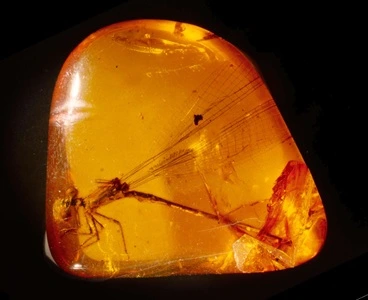 Baltic Amber is typically formed from the resin of ancient pine, spruce or Cedar trees. Amber from the Dominican Republic and Mexico is typically formed from the now extinct hymenaea protera tree, which was a relative of the modern Carob tree. The formation process begins when a tree is damaged. As a defence mechanism, the tree starts to produce resin in order to seal the damaged area, in an attempt to stop fungus and/or wood-boring insects from entering. Resin is a thick, hydrocarbon substance specifically designed for defence and should not be confused with sap. Sap is a thin and watery fluid used to transport nutrients and does not have the chemical structure required to survive fossilisation. As the resin is secreted onto the damaged area, it will flow down the branch or trunk of the tree and pool in crevices. It is at this stage, while it is sticky, that insects or debris can become trapped within it. As it is exposed to the air and sunlight, it will start to harden. If the tree remains intact, the resin will start to degrade and eventually decay. However, if the tree quickly becomes buried in an oxygen-free environment, such as silt, then the fossilisation process can begin. Over thousands of years, the resin undergoes an initial hardening. At this stage, it is known as Copal. As further layers of sediment built up over the buried resin, heat and pressure are produced. At this stage, the resin undergoes a chemical process called polymerisation, whereby the resin molecules link together to form Amber. This polymerisation process can take millions of years.
There are large deposits of Amber on seabed of the Baltic. This sea Amber is quite solid and was frequently harvested by fishermen. It can also wash up on beaches after heavy storms. Currently, Russia is the world’s largest producer of Amber, supplying about 80% to 90% of global production. Other producers include Ukraine, Poland, Dominican Republic, Lithuania, Latvia, Estonia, Myanmar, Mexico, and Indonesia.
Treatments
The vast majority of Amber on the market is treated, particularly the Baltic variety. Treatment is typically applied to improve its clarity and colour. Natural raw, untreated Amber will always command a premium price. However, treated specimens are more affordable and widely available, plus they can be just as aesthetically beautiful.
Common Treatments
- Clarification: This process involves heating the stone in oil, typically rapeseed oil. The oil will penetrate the stone and fill any tiny air bubbles within the structure. This will clarify cloudy or milky specimens, resulting in a transparent and honey-coloured finished product.
- Oxidation: This process involves baking the stone in an oven to create an oxidised surface layer. Resulting in a darkening of the stone, for example, this process can change a pale yellow specimen into a cognac or cherry-red colour.
- Sun Spangles: This process involves heating the specimen and then rapidly cooling it, which will cause internal fractures. These internal fractures typically appear as leaf patterns or circular patterns. These are then frequently marketed as “Scales” or “Plant Inclusions”, which of course they are not.
- Dyeing: This process involves dyeing poor-quality specimens to create the rare deep red or green colour.
Structural Treatments
- Pressed Amber: This process involves heating small scrap pieces and even dust, then pressing them together into one piece using hydraulic pressure. This process produces very affordable Amber, but the downside is that it tends to show elongated bubbles and quite often the edges where the different pieces meet can be seen.
- Stabilisation: This process involves using high pressure and heat to replicate the fossilisation process. This treatment is applied to brittle specimens to reinforce their structure.
Durability
Amber has a hardness rating of 2 – 2.5 on the Mohs scale. As such, this gemstone is considered very soft and delicate. To give you a comparison of its hardness, a human fingernail is about 2.5 on the Mohs scale. So literally, you can scratch this gemstone with your own nail. Although this gemstone has no cleavage, meaning it does not have a plane of weakness within its structure, it is a brittle gemstone. So it can easily be chipped or fractured upon impact. As such Amber is not suitable for everyday wear, particularly for rings and bracelets that are prone to impacts. Jewellery such as earrings and necklaces that are more protected could be worn more frequently.
- Sunlight: Amber is highly sensitive to sunlight, prolonged exposure to UV rays will cause this gemstone to darken in colour (oxidation) and to lose its lustre, becoming dull in appearance. Sunlight can also cause it to dry out, which can lead to crazing on the surface.
- Heat: Amber is sensitive to thermal shock. Sudden and rapid changes in temperature can cause internal fractures, known as “Sun Spangles”. It should be noted that this gemstone has a melting point of between 200°C to 380°C. Also Amber will ignite and burn if it comes into contact with an exposed flame.
- Chemicals: This gemstone is very sensitive to chemicals. As such even mild household chemicals and cleaning agents can irreversibly damage it. Often resulting in a whitish colouration forming on its surface. Contact with makeup, perfumes and lotions should also be avoided. It is recommended to always apply these products first and then put on your jewellery, so as to avoid direct contact.
- Cleaning: The safest and most recommended way to clean your Amber jewellery, is with lukewarm water and a soft cloth. Dampen the cloth and simply wipe your jewellery gently and dry afterwards. The use of steam cleaners or ultrasonic cleaners is not recommended and should be avoided, as should all cleaning agents even if mild.
- Storage: Amber is a delicate gemstone, as such it should be stored in a cool dark place and it should not be allowed to come in contact with other gemstones, which can easily scratch it. It should be stored in a separate compartment in your jewellery box or if this is not available, then it is best to place it in a soft cloth pouch.
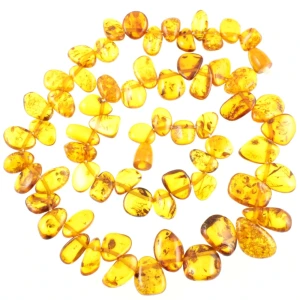
Imitation Amber
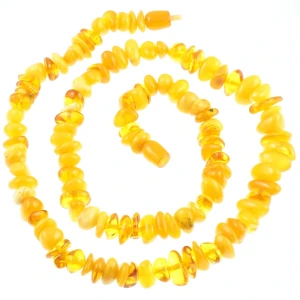
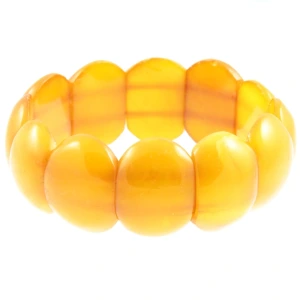
There are a number of imitations currently on the market. These range from “young resins” to polymers and or Glass. Outlined below are the most common imitations.
- Copal: This is young resin, although it is real tree resin and is hundreds if not thousands of years old, it has not fossilised yet. Copal is often sold as “young Amber” and it is considerably softer than if it were fossilised. To test, Copal will become sticky if it comes into contact with acetone or alcohol.
- Polymer: Polymers or plastics are the most commonly used imitation material, particularly for beads. Identification of imitation plastics is mostly based upon the fact that they are too perfect, both in shape and colour. To test, plastic will release a burnt chemical smell when it’s heated.
- Pressed Amber: Although this is made from real amber, it is manufactured from scrap pieces and or dust. To identify it, it will often contain elongated gas bubbles, the boundaries are also often visible where the small pieces have been fused together.
- Glass: The colour and lustre of glass can be made to match real amber, however glass is heavier and colder to the touch.
Identifying real Amber versus fake Amber.
- Saltwater test: Real Amber will float in saltwater, imitations will sink.
- Static test: Real Amber will produce static electricity when it is rubbed. Imitations however will remain inert.
- Smell test: Real Amber will release a pine scent when rubbed or heated. Imitations will produce a burnt chemical smell or no smell at all.
- Inclusions: If real Amber contains inclusions, then they will likely be small and often times distorted, particularly so for insects. Imitations typically include large, clear and perfectly centered insects and other inclusions.
Meaning and Healing Properties
Amber symbolises the sun, life, and preservation. It was often referred to as “liquid sunshine” or “frozen sunshine” and has long been associated with the sun, representing warmth and vitality. Historically, it was seen as a source of protection and credited with the ability to ward off evil spirits. Since this gemstone contains trapped insects and organic matter, it came to symbolise the preservation of ancient knowledge. It has also been credited with a number of healing properties. It was said to have the ability to absorb both the physical and emotional pain from the wearer.
Chakra: Amber is primarily associated with the solar plexus chakra, which helps to promote confidence and personal empowerment. It is also associated with the sacral chakra, which helps to promote creativity.
Birthstone: Amber is an alternative birthstone for November. The traditional birthstones for November are Topaz and Citrine.
Zodiac Astrology: Amber is primarily associated with the star sign Leo. It is also associated with the star signs Aquarius, Taurus, and Scorpio.
Wedding Anniversary: Amber is primarily associated with the 34th wedding anniversary. There is no traditional material gift for the 34th wedding anniversary. However, Opal is listed as the modern gift for the 34th wedding anniversary.
History
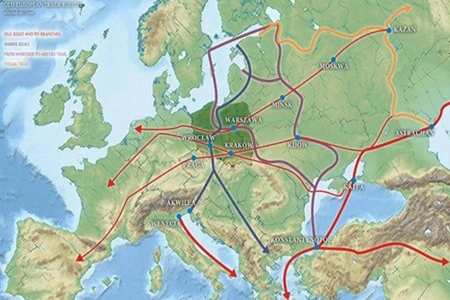 Amber and its uses has a very long history dating back over 13,000 years ago, to the stone-age. The majority of Amber from this time originates from the Baltic in northern Europe and it was one of the very first gemstones to be traded in prehistoric times. Stone Age people would gather this on beaches where it was frequently washed up, particularly after heavy winter storms. They used it to make beads, jewellery and buttons. During this time, it was used by Stone Age Hunters as a talisman, they would carve the gemstone into the shape of the animal which they were hunting, in the belief that this would bring them a successful Hunt. During the Neolithic period, there is evidence to suggest that Amber was used in rituals and as offerings, with large amounts of the gemstone being placed in particular lakes and bogs. One such example of this can be found in County Offaly in Ireland, where over 160 beads were discovered in a bog. From around 3400 BC onwards, the trading of Amber began to intensify across Europe and into the Mediterranean. By the Bronze Age, these trade routes, known as the “Amber road” were firmly established between the Baltic Sea and the Mediterranean, with the gemstone being traded as far as Egypt from the Baltic.
In ancient Egypt, Amber was very rare and highly prized. They associated it with Ra, the sun god and they would often refer to it as “Tears of the eye of Ra”. Baltic Amber has been found in the Tombs of the Pharaohs, dating as far back as 3,400 to 2,400 BC. It was not only a status symbol for the Egyptians but they also believed that it could offer them protection in the afterlife. One of the most famous examples of this is to be found in the breastplate of King Tutankhamun that features large pieces of Baltic Amber.
During the first century BC to the third century AD, under the Roman empire the trade in Amber from the Baltic flourished. The Romans highly prized this gemstone and often referred to as “Northern Gold”. The majority of it was brought to Aquileia, which is located Northeast of Italy. Here it was processed and carved into household objects such as boxes, goblets, utensils and combs. It was also used as a furniture inlay, as well as being widely used in jewellery. Lower quality pieces were also imported and would be used as incense. This was a popular gemstone amongst gladiators who would attach it to their fighting nets for good luck and protection. It’s used in Rome, reached its height during the reign of Emperor Nero. Who sent an expedition to the Baltic to secure vast amounts of Amber, which were used to decorate he’s amphitheatre. He had decorative armour made from it for the Gladiators and ordered the protective nets to be studded with pieces of Amber. He also had the sand in the arena sprinkled with Amber dust, so that it would sparkle in the sun. After the fall of Rome between the fourth and fifth centuries AD, the Amber Road with its extensive network of trade routes collapsed.
In the 13th century, the Teutonic Knights took control of the Baltic coastline and with it they controlled the entire Amber industry. A high-ranking knight would be appointed as “Bernsteinmeister” (Amber Master) to control the industry from Lochstedt Castle, located near present-day Baltiysk in Russia. Control was total and a brutal affair, local residents on the coastline had to swear an oath that they would not steal or hide any Amber found washed up on the shore. Anyone found in breach of this oath could be tortured and executed, even possessing a small piece was enough to be executed for. The Order of Knights were so strict, that local people could not even walk on the beaches without being accompanied by a warden. This monopoly funneled vast wealth into the Order’s coffers, which they used to build fortresses and to fund military campaigns. In 1525, the Teutonic Order was secularised but these strict laws remained in place in Prussia for centuries afterwards.
During the 15th and 16th centuries, a small amount of Dominican Amber made its way into Europe after Christopher Columbus first encountered it in the late 1400s. However, Dominican Amber would remain at a trickle into Europe until industrial mining in the 1950s and 1960s allowed it to compete with the sheer volume of the Baltic variety.
During the Georgian Era, Amber moved away from symbolising religion and royalty. The Georgians viewed it as an “honest” natural gemstone, which was appropriate for day wear. As opposed to Diamonds, which were considered evening wear. Long graduated strands of beads were very fashionable, as were carved animals and floral motifs made from Amber. It was also a popular accessory for gentlemen, who would often set it in the top of their walking canes to showcase their elegance.
During the Victorian Era, which was a sombre time due to the death of Prince Albert and the resulting popularity of mourning jewellery. Mourning jewellery strongly featured the use of Jet, which was widely referred to as “Black Amber”. However, this was only a nickname, since both gemstones were warm to the touch. In Victorian Sentimental jewellery, it was a popular gemstone symbolising love and longevity and later on during the Aesthetic period, it was commonly used in floral designs. Interestingly, the Victorians believed Amber had antiseptic properties which led it to be a popular choice of material for the mouthpieces of smoker’s pipes and cigarette holders.
Folklore
Amber has a rich folklore surrounding it, dating back thousands of years to the Stone-Age. To the Stone-Age people, this gemstone was seen as a “Living Stone”, since it was warm to the touch and it could produce a static charge. It was believed to be “Solidified Sunlight” and that it held the power to ward off evil spirits. It was widely used as a hunter’s talisman, they would carve the gemstone into the particular animal which they intended to hunt and either carry it with them or attach it to their weapons to ensure a successful hunt. This gemstone was also believed to protect the deceased in the afterlife and as such was often buried with the deceased. It was also used as an offering to their god(s), with large amounts of beads having been found in lakes and bogs. There is also evidence to suggest that they use it for medicinal purposes, by grinding it into a fine powder.
In ancient Egypt, Amber was a sacred gemstone and was associated with Ra, the sun god. They believed it was formed from the tears of the eye of Ra and as such it contained his life-giving essence. The Egyptians believed this gemstone held the power to ward off evil spirits and it was widely used in incense to purify their temples and palaces with its “Divine Smoke”. This power of protection was also believed to extend to the deceased. Small pieces of the gemstone were often placed under the skin of the hands of mummies, to protect them from both decay and evil spirits.
Greek Mythology: The ancient Greeks called this gemstone “Elektron” meaning “Beaming Sun”, a reference to its golden colour and the way in which it produces static electricity when rubbed. Incidentally, the word electricity is derived from this Greek word “Elektron”. In Greek mythology, the best-known legend about Amber is the story of Phaethon, who was the son of the sun god Helios. Phaeton tried to drive his father’s sun chariot across the sky but he lost control and scorched the earth. After this Zeus struck him down with a bolt of lightning and he fell into the mythical river Eridanos. Phaethon’s sisters stood on the riverbank crying for their brother, their golden tears fell into the river and were hardened into Amber. Because of this legend, the ancient Greeks saw Amber as a mourning stone and would wear it at funerals and in memory of the dead. As a talisman, the Greeks believed it to be a “Victory Carrier” and it was often worn by soldiers and huntsmen to ensure success.
Roman Mythology: The ancient Romans largely believed that Amber was formed from the tears of Phaeton’s sisters from the Greek legend. There was also the belief at this time that Amber was fossilised Lynx urine. It was said that the higher quality, transparent varieties came from the male Lynx and that the darker coloured varieties came from the female Lynx. It was said that this gemstone had the power to both ward off evil spirits and to protect from madness. For this reason, it was commonly given as a bead necklace to children. Gladiators wore it as a talisman for protection and success. It was said that Emperor Nero would give Amber bracelets to his favourite gladiators to ensure their survival in the games. The gemstone was also credited with a number of healing properties. Pliny the Elder writes about how it was used for ailments of the throat, stomach and that it could be used to reduce a fever. He also documented that it was ground into a fine powder and mixed with honey and rose oil to treat ailments of the ear.
Medieval Europe: During the middle-ages in Europe, Amber was seen as a powerful protective gemstone, particularly against witchcraft and the evil eye. It was said that witches were unable to remain in the presence of Amber. In Scotland, they had the custom of stringing Amber beads on red string to protect the wearer from witchcraft and evil spirits. The gemstone was also widely used to protect infants from evil. It was typically placed on the child as a bead necklace, in the belief that it could attract evil onto itself and so delay it reaching the child.
Medieval physicians credited this gemstone with a number of healing properties. It could be used as pain relief for teething children and to help with pain from arthritis. Interestingly, it is still used to the present-day by some people for teething children. Although this practice is strongly advised against by health organisations. Medieval physicians would grind it into a fine powder and mix it with wine or beer as a cure for ailments of the stomach. It was also believed that by looking through a piece of Amber, vision could be improved.
In the Catholic Church, Amber symbolised purity, divine light and the glory of God’s presence. It was widely used in religious art and reliquaries, as well as to make rosary beads, episcopal rings, and pectoral crosses. It was and still is used as an ingredient in incense for its pleasant smell and cleansing properties.
Famous Amber
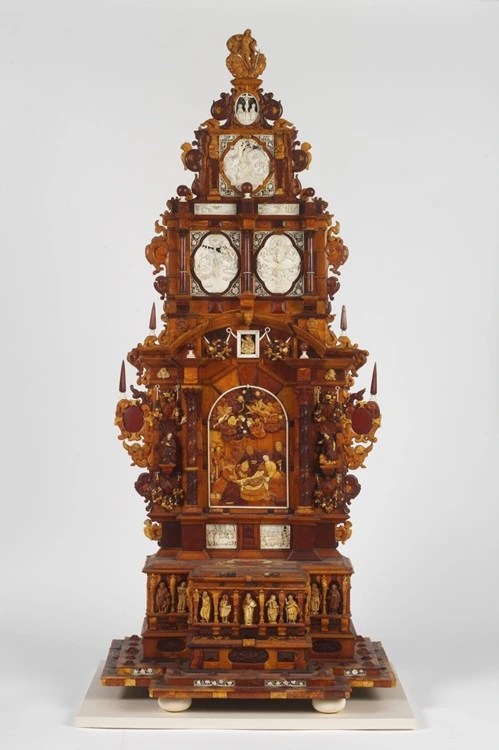
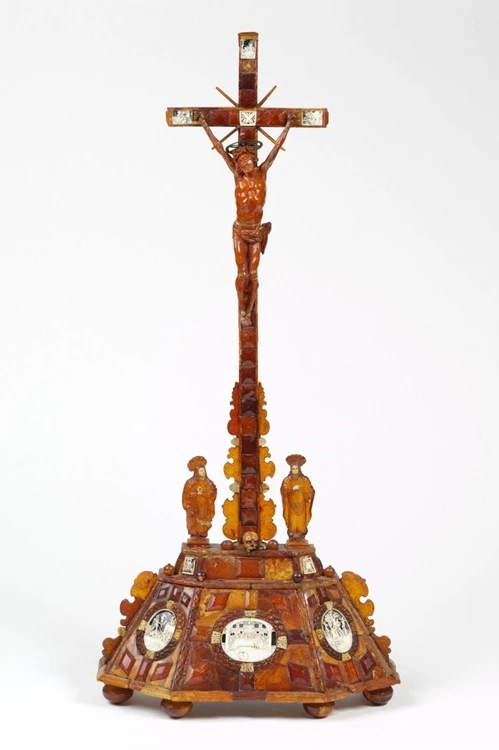
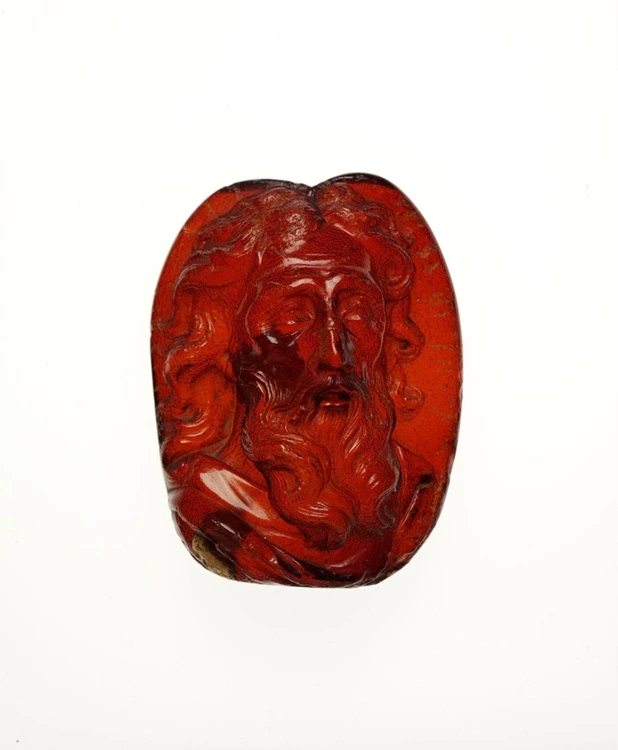
The above pieces of Amber are on display at the V&A Museum.
Amber Gemological Data
Colour: Yellow, orange, golden honey, cognac brown, red, and other colours.
Colour of Streak: White.
Mohs hardness: 2 – 2.5
Density: Mostly 1.05 – 1.09
Cleavage: None.
Fracture: Conchoidal, brittle.
Crystal system: Amorphous.
Transparency: Transparent to opaque.
Chemical composition: C10H16O approx, mixture of various resins.
Refractive index: 1.539 – 1.545
Double refraction: None.
Pleochroism: Absent.
Dispersion: None.
Fluorescence: Blue, bluish-white to yellow-green, orange.
For Researchers and Journalists
Recommended Citation (MLA) Format:
Hoyne, John. “Amber: Formation, History, Meaning, and Folklore.” Carus Jewellery, n.d., https://carusjewellery.com/amber/.
You can also get in touch with Carusjewellery.com on Facebook , where you may leave any comments or questions you may have about this article.