Opal
The name Opal is derived from the Indian word “Sanskrit” which means stone. Opal gemstone is divided into 3 subgroups:
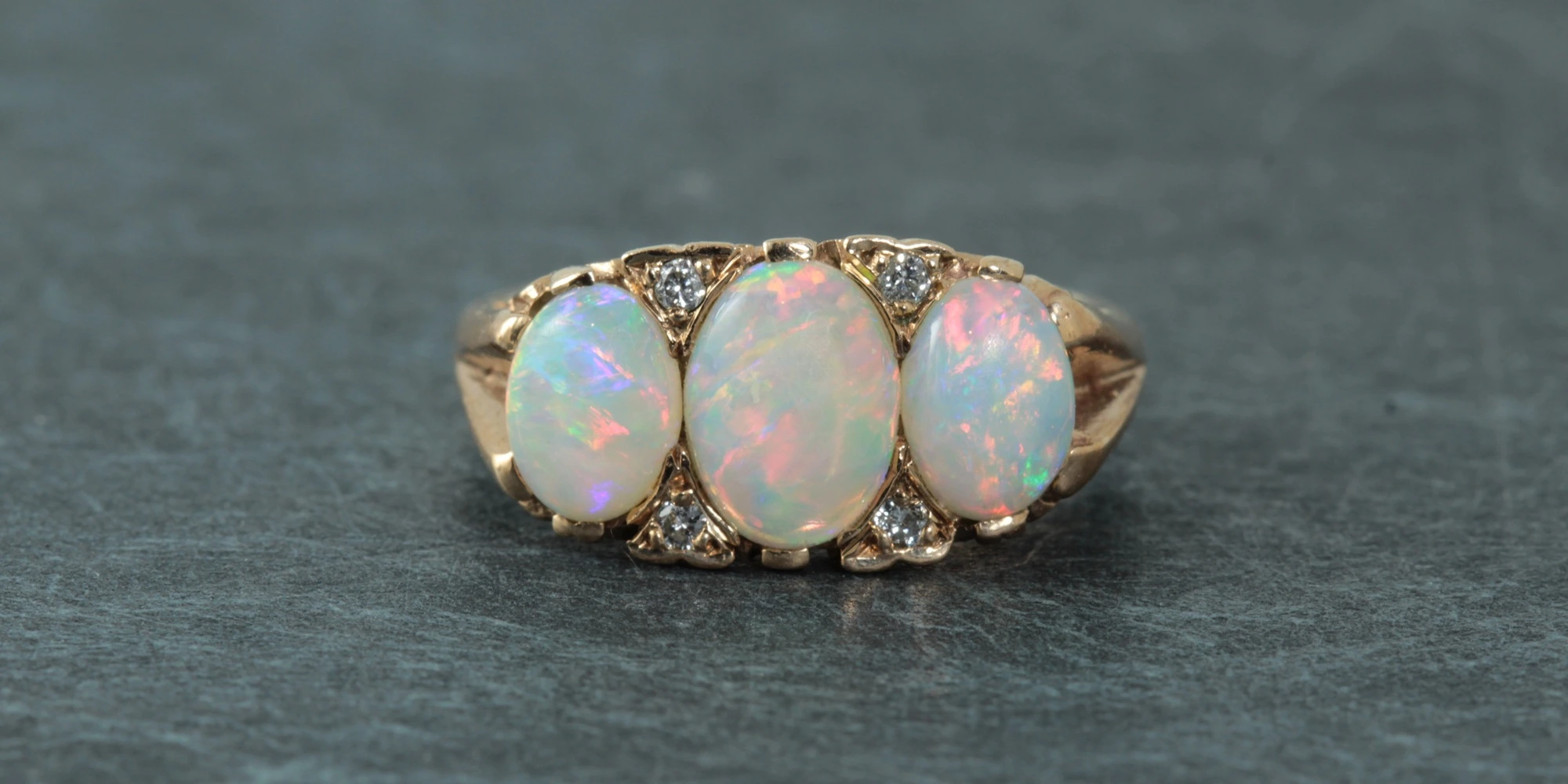
- Precious Opal: Precious Opal displays a “Play-of-Colour” (iridescence). This play-of-colour is produced as a result of the silica spheres being arranged in a regular formation that diffract light. Within this subgroup there are different varieties. Black Opal, has a dark colour and so makes the play-of-colour appear more vibrant. Black Opal is considered the most valuable of all the varieties. Next in this group is White (clear) Opal, which is translucent to opaque white or light grey. Also in this group is Crystal Opal, which is transparent to semi-transparent and shows a vivid play-of-colour.
- Common Opal: Common Opal or Potch as it is often referred to, has no play-of-colour. Potch has very little commercial value, however, there are some uses for it. For example, it is used as a backing for doublets and triplets. This is where a thin slice of Precious Opal is glued onto the back of potch. Potch can also be used as practice material for gemstone cutters. Within the potch group, there are a number of varities. Hyalite, which is a crystal clear, colourless potch. Pink or blue potch, typically found in the Andes and has no play-of-colour. Also in this group is wood potch.
- Fire Opal: Fire Opal displays little to no play-of-colour but is valued for its uniform vibrant colour and high transparency. Its colours are typically vivid yellows, oranges and reds. Unlike other Opals, Fire Opal is often faceted to enhance its brilliance. On rare occasions, specimens containing a play-of-colour are found and these are referred to as Precious Fire Opal.
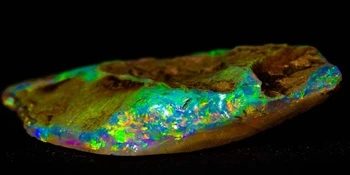 Formation: All varieties of Opal are composed of hydrous silicon dioxide however, they do not all form in the same manner. The formation process starts with either water or hydrothermal fluids seeping through the ground, dissolving silica from sedimentary rock or volcanic ash. This silica-rich water then collects or pools in voids or fissures in the host rock. Where over time the water will evaporate, leaving behind microscopic silica spheres which solidify. It is at this stage that the varieties of Opal differ in their formation.
- Precious Opal: As the water evaporates from the silica-rich solution, the silica spheres left behind are of uniform size and arrange themselves in a perfect grid formation. This grid formation then acts as a prism which diffracts light into the play-of-colour we see.
- Common Opal: As the water evaporates from the silica-rich solution, the silica spheres left behind are of different sizes and are jumbled. Since no grid structure could be formed, there is nothing to act like a prism and so the light cannot diffract. Resulting in no play-of-colour.
- Fire Opal: Fire Opal forms when a silica-rich solution passes through volcanic ash or lava. The vivid uniform colour ( yellow, orange, red) is produced by the inclusion of iron oxide during its formation, rather than the ordered structure of the silica spheres. Although in rare cases, an ordered structure of the silica spheres does take place. In which case, these specimens would be referred to as “Precious Fire Opal”. The formation process of Fire Opal is significantly faster, within thousands of years. As opposed to the formation of sedimentary Opal, which is a process that can take millions of years.
Treatment: Natural, untreated Opal will always command a premium price over treated Opal, due to its rare natural beauty. As a general rule, it is quite common for Opal to be treated. Treatment is normally applied to improve the stone`s appearance and or its structural strength.
- Sugar-Acid: This treatment involves the stone being steeped in a sugar solution, after which the stone is placed in sulfuric acid. The acid carbonises the sugar, turning the stone black which intensifies its play-of-colour. While this treatment is permanent, it only affects the surface of the gem. As such if the stone ever needed to be re-polished, this could expose the untreated material below the surface. This sugar acid treatment is commonly applied to Andamooka Matrix Opal.
- Dyeing: Lower-quality porous specimens can be dyed to change its colour. It should be noted that most of these dyes are unstable and tend to fade over time. They are also sensitive to sunlight, which will accelerate the fading process.
- Smoking: Lower-quality porous specimens can have smoke treatment applied to them. This will darken the stone`s colour and enhance its play-of-colour. This treatment is not permanent and tends to fade over time. This smoke treatment is commonly applied to Ethiopian Opals.
- Polymer Impregnation: Lower-quality stones or those which contain fissure or cracks that reach the surface. Can be impregnated with a clear polymer or resin under pressure. This treatment is permanent and will improve both the stone`s structural strength and its appearance.
- Surface-Coatings: A very thin coating of vaporised metal oxides, typically aluminium oxide can be applied to the back of the stone. This will darken the stone`s colour and so enhance its play-of-colour. This treatment works in a similar manner to foil-backed gemstones, which was a technique commonly used in Georgian Jewellery. It should be noted that unlike foil-backed gemstones, applying vaporised metal oxides is not permanent and it will tend to wear away over time.
Composites:
- Doublets: A doublet is created by glueing a slice of Precious Opal onto a backing of black potch or similar material such as ironstone. The advantages of a doublet are that it will have a natural appearance, with an organic feel to it, while being more reasonably priced. To identify a doublet, it should be viewed from the side where the two distinct layers will be visible with a glue line showing between the layers. One disadvantage of a doublet is that they are sensitive to moisture. If they are allowed to get wet for prolonged periods or are stored in damp conditions. Then the glue can dissolve and the layers will delaminate.
- Triplets: A triplet is created by glueing a paper-thin slice of Precious Opal onto a backing of black potch or similar material such as ironstone. Then a clear dome-shaped cap is placed on top to mimic a cabochon. This dome cap is typically made of rock crystal, glass or plastic. The dome-shaped will magnify the gemstone underneath and create a glassy appearance to the triplet. To identify a triplet, it should be viewed from the side. Where the three distinct layers will be visible along with two glue lines. Triplets are sensitive to moisture, so prolonged exposure to water or if stored in damp conditions the glue can dissolve and the layers will delaminate. The main advantage to triplets is that you can acquire a large piece at budget-friendly prices.

Durability: Opal has a hardness rating of 5.5 to 6.5 on the Mohs scale of hardness, which makes it about as hard as glass. As such this gemstone is more suitable for occasional wear, rather than everyday wear. This is particularly the case for rings and bracelets, which are more prone to impacts. Other more protected jewellery such as earrings and necklaces could be worn more frequently providing care is taken.
Sunlight: Opal is extremely sensitive to sunlight, prolonged exposure to UV rays will cause the stone to dry out and or crack. Resulting in a loss of its play-of-colour. Sunlight will also cause this gemstone to fade in colour or even to change colour.
Heat: Opal typically contains between 3 to 30 percent water. As such it is very sensitive to heat, which will cause the stone to dry out and lose its play-of-colour and even to crack. Care should also be taken to avoid rapid changes in temperature with this gemstone as it is sensitive to thermal shock due to its water content.
Storage: Opal is a relatively soft gemstone and as such it should be stored in a soft cloth pouch to keep it from being scratched by other jewellery. For long-term storage, it is recommended to place it in a sealed plastic bag containing a damp cotton ball. This will help to maintain the stone`s water content. It should be noted that this is not advisable for doublets or triplets, as damp conditions will lead to the glue dissolving and the doublet or triplet will delaminate.


Meaning and Healing Properties
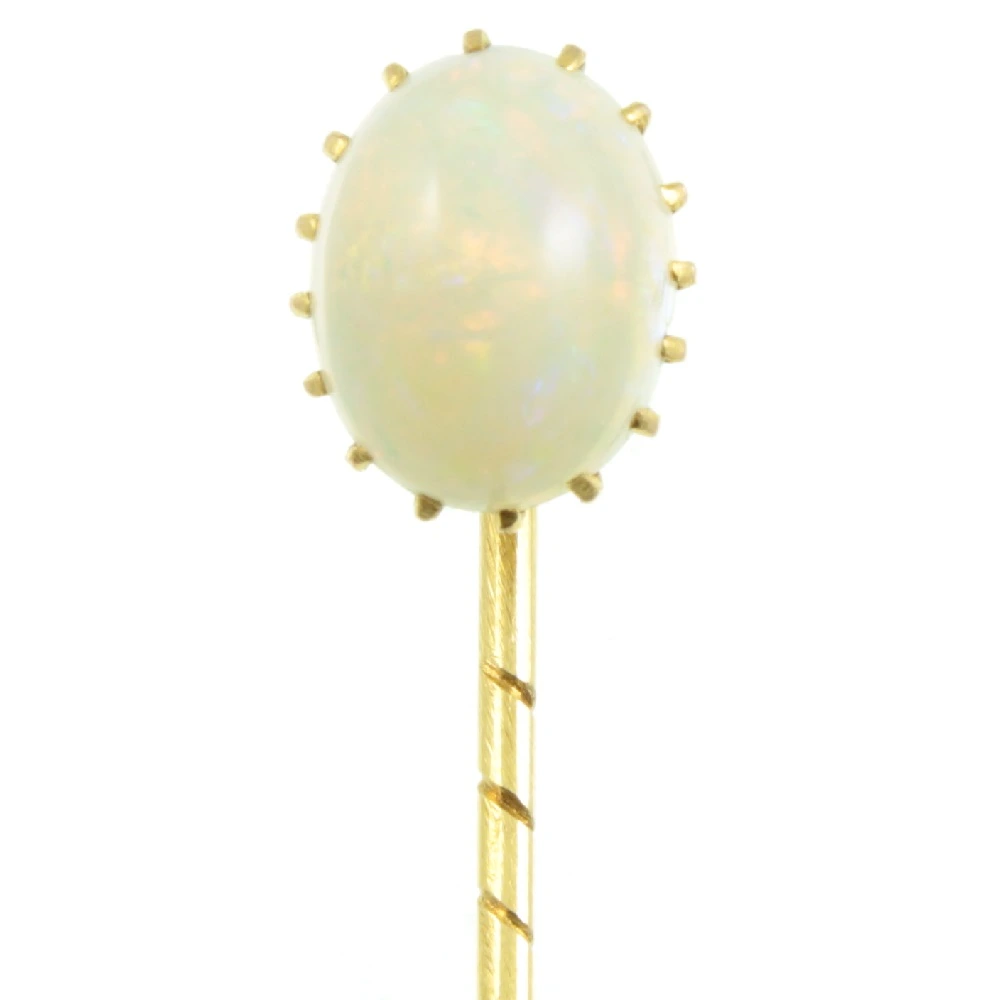
Throughout time, Opal has symbolised hope, purity, truth and good luck. This stone was believed to be a “Karmic Stone” whereby it would sense the wearer`s feelings, amplify them and return them to the wearer. Which was said to encourage self-reflection and lead to self-growth. The stone was said to help artists and writers by removing creative blocks and sparking creativity. It was also used as a protective stone and said to prevent nightmares.
This gemstone was said to help balance the wearer`s emotions and to reduce anxiety. It encourages the wearer to release old emotional trauma and to promote self-acceptance.
Historically, this gemstone has been associated with a number of healing properties. It was commonly referred to as the “Eye Stone” and was thought to improve the wearer`s vision, as well as helping with ailments of the eyes. It was also credited with boosting the immune system and detoxifying the blood, particularly helping to detoxify the kidneys and liver.
Chakra: This gemstone is associated with all seven chakras by colour:
- Black: associated with the Root chakra, which helps promote stability and grounding.
- Fire/Orange: associated with the Sacral chakra, which helps promote creativity and passion.
- Yellow/Honey: associated with the Solar Plexus, which helps promote self-confidence and personal empowerment.
- Pink/Green: associated with the Heart chakra, which helps promote love, healing and compassion.
- Blue: associated with the Throat chakra, which helps promote communication and self-expression.
- Purple/Violet: associated with the Third Eye, which helps promote intuition and spiritual insight.
Birthstone: Opal is the traditional birthstone for October, along with Tourmaline.
Zodiac Astrology: Opal is most closely associated with the star signs Libra and Scorpio.
Wedding Anniversary: Opal is the traditional gemstone gift for the 14th wedding anniversary, symbolising hope and purity.
History
The earliest known mining of Opal was in Ethiopia and dates back to about 4,000 BC. Opal from Ethiopia was traded with Kenya, where it has been discovered in archaeological finds of beads and small tools. It is also believed to have been traded with the ancient kingdom of Israel and with the Roman Empire. It is thought that much of Ethiopia`s mining history was small-scale localised operations, of which very little has been recorded. Commercial mining operations began in the 1990s. In 1994, the first modern discovery was found at Yita Ridge. However, the stone found here suffered from “crazing” which is caused by drying out, which limited demand. In 2008, a major deposit of high-quality Opal was discovered near Wegel Tena in the Wollo province. Specimens mined here are of excellent quality with a vibrant play-of-colour. In 2013, another significant deposit of black Opal was discovered at the Stayish mine in the Wollo province.
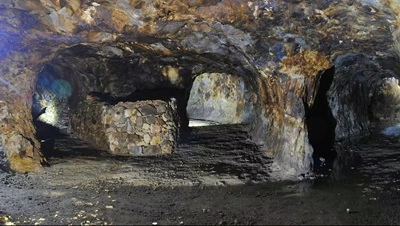 Historically, the Dubnik mines in Slovakia were an important source. The Dubnik mines are located in the Slanske Vrchy mountains which are part of the Carpathian mountains and mining there dates back as far as 400BC. These mines were the world`s only significant source of Precious Opal until deposits in Mexico and Australia were found in the 19th Century. During the Roman Empire, legend has it that traders told the Romans that the stone was mined in India to protect the mines location. This lie was widely accepted and believed by the Romans at the time. During the middle-ages the Dubnik mines came under the control of the Hungarian Empire. This lead Opal mined in Dubnik to become known as “Hungarian Opal” a name which stuck. In the 16th Century, Isabella Jagiellon received a wedding gift of a necklace featuring 16 Dubnik Opals, which became known as “Isabella`s Necklace”. This stunning necklace highlighted the royal status of Opal during this period. Isabella`s necklace is currently housed at the National Museum in Budapest. Production at the Dubnik mines reached their peak between 1845 to 1880. With over 350 workers been employed and producing around 25,000 carats per year. A staggering amount which is comparable to modern production currently in Australia. From around 1896 onwards the mines at Dubnik when into decline as historical deposits became largely depleted and with new finds in Australia which lowered prices. Operations officially stopped in 1922 because of flooding in the mine.
In Mexico, Opals have been mined and revered by the Mayan and Aztec people for thousands of years. The Aztecs called it “Vitzitziltecpatl” which means hummingbird stone, because of the iridescent colours. After the Spanish conquest of Mexico, most of the mines were lost to time and would not be rediscovered for centuries. In 1835 deposits were rediscovered in Queretaro, which lead to the beginning of large-scale commercial mining in the region. In 1870, the Santa Maria Iris mine began operations in Hacienda, Esperanza. The Santa Maria Iris mine became the most famous mine in Mexico, producing transparent and high-quality Opal. This mine produced a variety of specimens including Precious Opal, Water Opal, Crystal Opal, Matrix Opal and Hyalite. During the late 1950s major deposits discovered near Magdalena, Jalisco. Which lead to a boom in the area between 1965 to 1975, with hundreds of small-scale mines opening. International demand from collectors and jewellers in Europe and Japan was at an all time high during this period. Which by the 1980s had lead to the deposits at both Jalisco and Queretaro becoming largely depleted. Today mining does still continue but it is mostly small-scale operations.
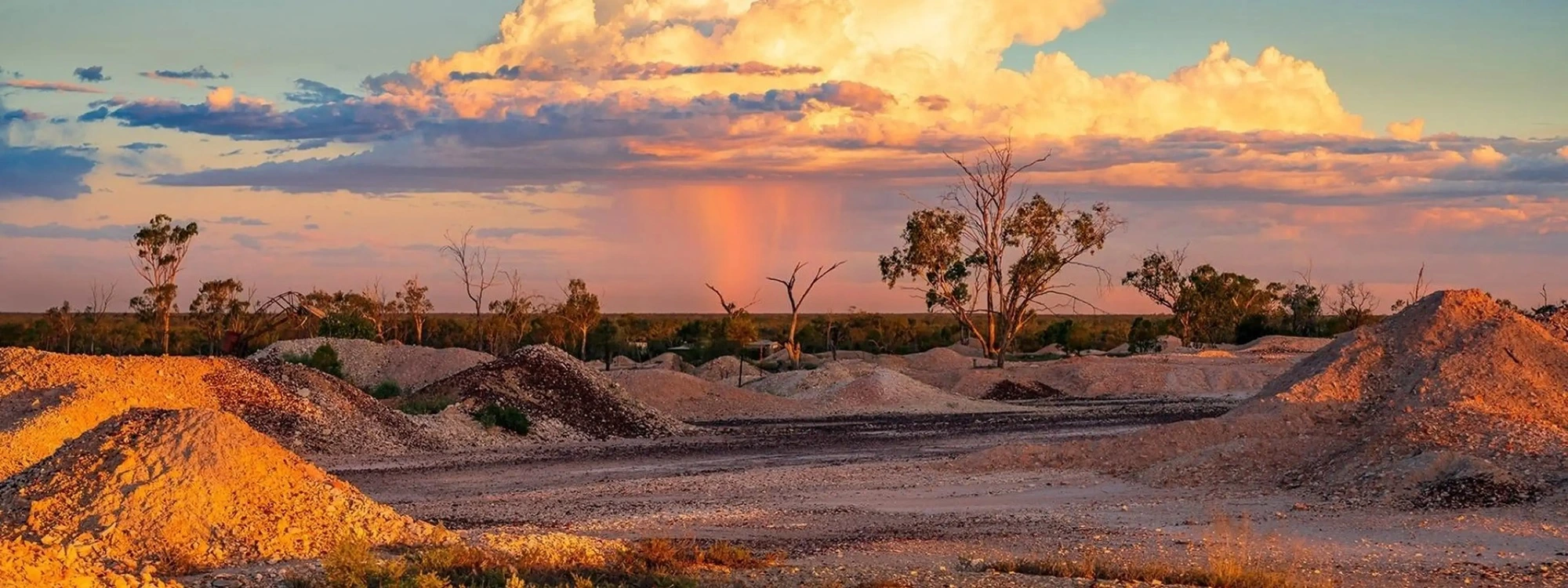
Australia is currently the dominate global producer of high-quality Opal. It started back in 1841, when Johannes Menge a German geologist discovered potch near Angaston in South Australia. Commercial mining began in 1875 in Listowel Downs in Queensland and at White Cliffs in 1884. During the early 1900s a further three major deposits where discovered, Lightning Ridge (1905), Coober Pedy (1915), and Andamooka (1930). Each of these new finds sparked a huge rush and by 1932 Australia was the world`s leading producer.
Lightning Ridge: Lightning Ridge, located in New South Wales is the world`s only commercial source of the rare Black Opal. The gemstone produced here is of exceptionally high-quality with a vivid and intense play-of-colour against a black background.
Coober Pedy: Coober Pedy is located in South Australia and is the largest mining area in Australia for Opal. This area produces white and crystal varieties and has a very good play-of-colour. The crystal specimens from this area are transparent to semi-transparent.
Andamooka: The Opal fields of Andamooka are located in South Australia and are famous for producing crystal and matrix Opal. The region is also famous for producing the “Queen`s Opal” which weighed 203 carats and was gifted to Queen Elizabeth II in 1954.
Folklore
Opal and its use has a very long history, dating back over 6,000 years. Ancient civilisations used the stone for religious purposes and as a talisman for protection. Since this is an iridescent stone containing all the colours of the rainbow in a complete play-of-colour. It was widely believed to have all the virtues of every other gemstone. In Indian mythology, the stone was believed to be the goddess of the rainbow who turned herself into stone. In order to avoid the persistent advances of the other gods. An Arabic legend tells that the stone fell from the heavens in flashes of lightning, thus explaining its play-of-colour. The ancient Egyptians associated the stone with the sun god Ra and they also viewed it as a status symbol. It was widely used in jewellery for the pharaohs and wealthy individuals. They also believed that the stone had protective powers and would include it in burial sites along with the deceased.
Greek Mythology: In Greek mythology, Opal was associated with Zeus, the king of gods. It was said that after he was victorious against the Titans, he wept for joy. These tears fell to the ground and crystallised into Opal. The ancient Greeks also associated the stone with Aphrodite, goddess of love. They believed the stone held the power of prophecy and it was used by oracles for scrying (fortune-telling). The Greeks called the stone “Opallios” which means to see a change. They also believed that the stone held the power of protection against illness, particularly ailments of the eyes or skin.
Roman Mythology: In Roman mythology, the stone was associated with Cupid and was commonly called “Cupid Stone”. To them, the stone symbolised love and passion. They also associated the stone with Venus, goddess of love and believed the stone was created from her tears of joy. Pliny the Elder describes the stone as being “above all others” and to “defy description”. He gave a description of the play-of-colour as resembling the “flame of burning sulphur” or like “fire quickened by oil”. However, he incorrectly states that the stone`s origin was India. This was a lie perpetrated by gemstone traders at the time to conceal the stone`s true origin which was in Slovakia. This may have been to prevent the Romans from trying to capture the mine in Slovakia or possibly to make the stone sound more exotic. The Romans called the stone “Ophthalmos” which means “Eye Stone”. They believed it could cure all ailments of the eyes. They also used the stone extensively in their jewellery and viewed it as a status symbol.
Medieval Europe: During the middle-ages in Europe, the stone was viewed as a rare thing of beauty and a powerful talisman to ward off the “Evil Eye” and bring good fortune, as it was believed to be a particularly lucky gemstone. Since it contained all the colours of the rainbow in complete play-of-colour. The stone was said to have the ability to mirror the wearer`s mood and or health and would change colour or lose its play-of-colour should the owner become unwell or upset. This belief was heightened during the Black Death. When, it was said that if the wearer caught the Black Death, then the stone would start to glow brightly. Then the stone would lose its play-of-colour and become dull if the wearer died. Along with mirroring the owner`s health, the stone was said to mirror the owner`s virtues. Becoming dull and losing its play-of-colour should the owner be dishonest or unfaithful.
The stone was also worn during this time for medicinal purposes. It was said to cure ailments of the eyes and to improve vision for the wearer. While at the same time obscuring the vision of other people seeing the wearer. This lead to the belief that the stone could allow the wearer to become invisible or partially invisible. There was a practice at the time of wrapping Opal in a fresh bay leaf and carrying it on their person, in the belief that it would make them invisible. This lead the stone to become known as the “Patron Stone of Thieves”.
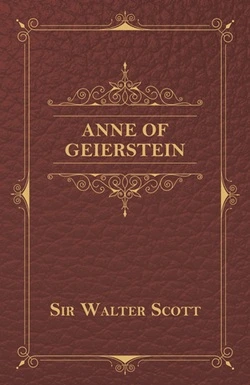 19th Century: In 1829, Sir Walter Scott wrote a novel called “Anne of Geierstein”. In this novel, the Baroness of Arnheim wore an Opal talisman which was said to have supernatural powers. In the story, a drop of holy water fell on it and it lost its play-of-colour, becoming colourless and dull. Shortly afterwards, the Baroness dies. This novel was very popular at the time and people started to believe that the gemstone was unlucky. So much so that within one year of the novel being published, sales of Opal fell by 50% in Europe and remained low afterwards. Belief was so strong about the stone being unlucky, particularly in Russia. It was said that if a Russian saw an Opal amongst other items for sale, that not only would they not buy the Opal but would not touch any of the other items. In the belief that they too had become unlucky by association.
The stone`s reputation was single handedly rescued by Queen Victoria. She had a lifelong love of jewellery and gemstones, with Opal being no exception. She gifted suites of Opal jewellery to each of her five daughters on their wedding day and she wore the stone frequently herself in public. Her husband Prince Albert was also a lover of jewellery and gemstones. He actually designed an Opal tiara for her. In 1887, Queen Victoria met with H.W. Bond who was nicknamed “King of Opals”. At the meeting she selected stones from him, which she used to have new jewellery made. This lead to the stone returning to fashion and became the new rage in London and across Europe. Finally ending the stones association with bad luck.
Famous Opal
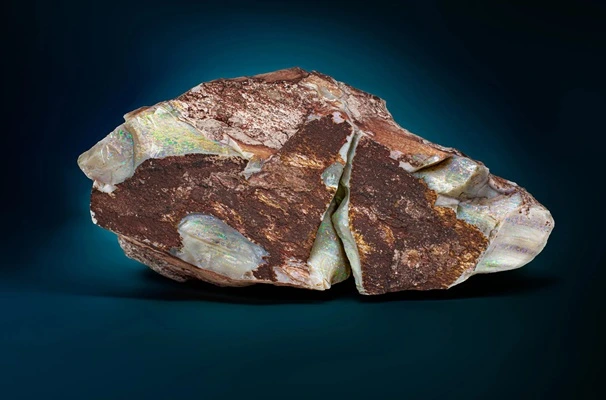
THE OLYMPIC AUSTRALIS
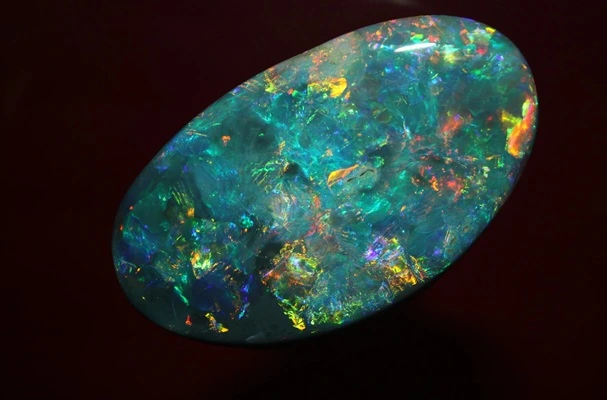
AURORA AUSTRALIS
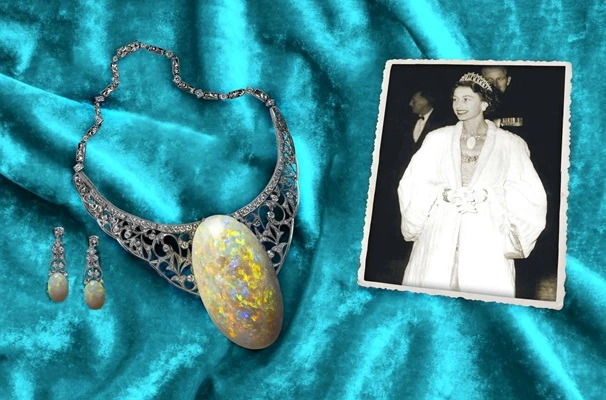
THE QUEEN’S OPAL
Precious Opal Gemological Data
Colour: All colours, partially-play-of-colour.
Colour of Streak: White.
Moh`s hardness: 5.5 – 6.5
Density: 1.98 – 2.50
Cleavage: None.
Fracture: Conchoidal, splintery, brittle.
Crystal system: Amorphous; kidney/grape shaped aggregates.
Transparency: Transparent, opaque.
Chemical composition: SiO2·nH2O hydrous silicon dioxide.
Refractive index: 1.37 – 1.52
Double refraction: None.
Pleochroism: Absent.
Dispersion: None.
Fluorescence: White Opal: white, bluish, yellowish to brownish, greenish. Fire Opal: greenish to brown.
For Researchers and Journalists
Recommended Citation (MLA) Format:
Hoyne, John. “Opal: Formation, History, Meaning, and Folklore.” Carus Jewellery, n.d., https://carusjewellery.com/opal/.
You can also get in touch with Carusjewellery.com on Facebook , where you may leave any comments or questions you may have about this article.
